Industrial Chiller Maintenance Checklist
A production line rarely stops because of one dramatic failure. More often, it slows down because a chiller runs a little warmer than usual, a condenser gets dirty, water quality slips, or a small refrigerant issue goes unnoticed for weeks. That is why an industrial chiller maintenance checklist matters – not as paperwork, but as a practical control tool for uptime, energy use, and equipment life.
For factory managers, MEP teams, healthcare operators, and maintenance supervisors, the value of preventive maintenance is straightforward. A well-maintained chiller holds temperature more accurately, supports stable process conditions, and reduces the risk of unplanned shutdowns. In temperature-sensitive applications such as packaging, food processing,
cold rooms, and dialysis cooling, that stability directly affects output quality and operational continuity.
What an industrial chiller maintenance checklist should achieve
A good checklist does more than remind a technician to “inspect the unit.” It should help your team verify operating conditions, catch gradual performance loss, and document trends over time. The best maintenance programs are not built around guesswork. They are built around measurable readings such as entering and leaving water temperature, suction and discharge pressure, amperage, water flow, and approach temperature.
This is where many facilities lose efficiency. A chiller may still be running, but not running correctly. If condenser fouling raises head pressure, or evaporator performance drops because of poor water treatment, the equipment may continue to operate while consuming more power and delivering less reliable cooling. A checklist turns those hidden losses into visible maintenance actions.
Daily and weekly checks that prevent bigger failures
The first layer of maintenance is routine observation. Operators should confirm that the unit starts, runs, and cycles normally without unusual alarms, vibration, or noise. This sounds basic, but a change in sound from a compressor, fan motor, or pump often appears before a full mechanical problem.
Record supply and return water temperatures and compare them against design conditions. If your process requires tight control, even a small drift can signal fouled heat exchangers, low refrigerant charge, inadequate flow, or sensor error. Also review pressure gauges, oil levels where applicable, and controller alarm history. One alarm reset is not always a solved problem.
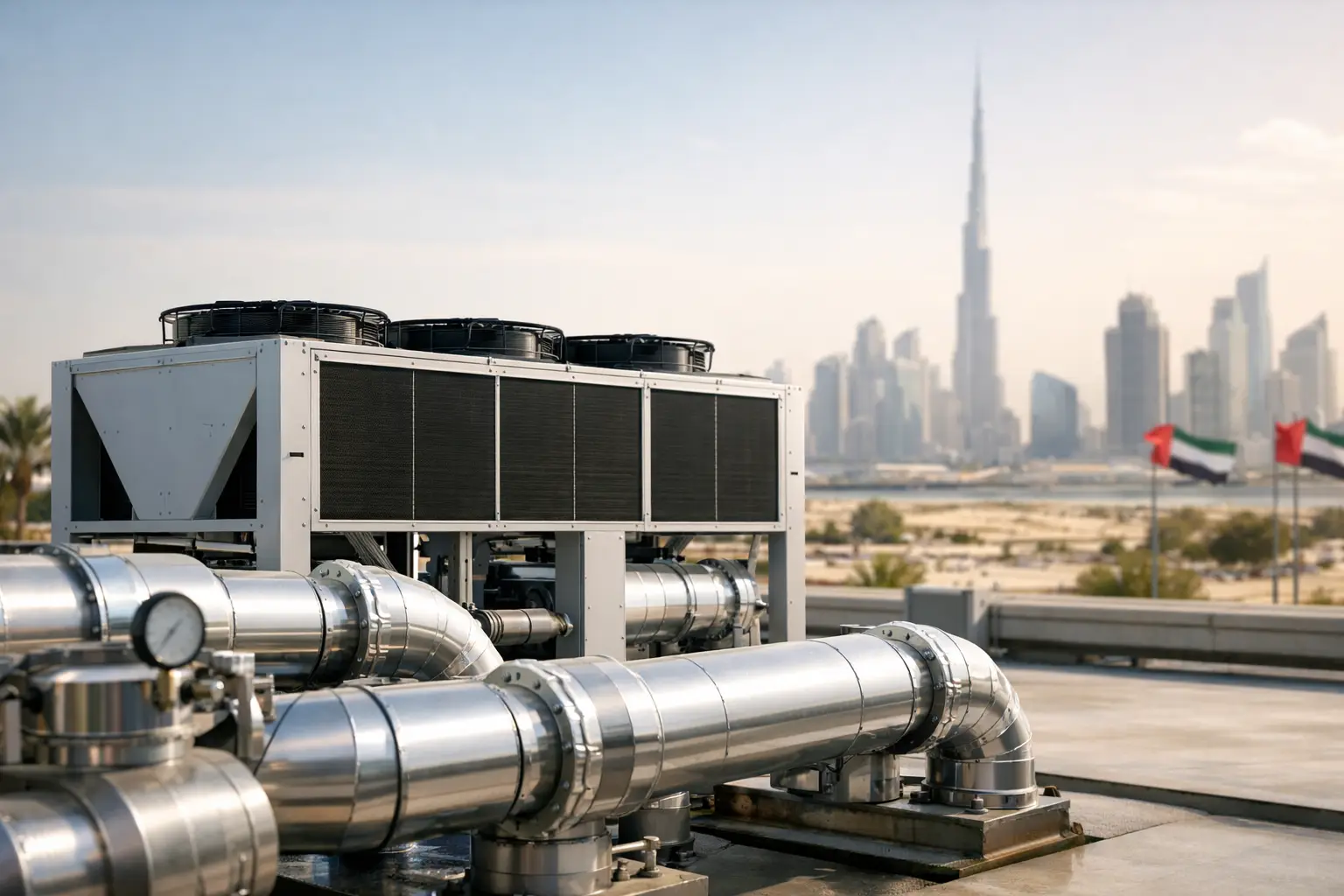
For air-cooled industrial chillers, weekly checks should include condenser coil cleanliness, fan operation, and airflow obstruction around the unit. In UAE and GCC environments, dust accumulation can build quickly, especially in industrial yards, rooftops, and semi-exposed service areas. A coil that looks only slightly dirty can still affect condensing temperature enough to increase compressor load.
For water-cooled systems, cooling water condition and flow stability deserve close attention. Scale formation, strainer blockage, and poor tower performance can reduce heat rejection long before the chiller trips on fault.
Monthly industrial chiller maintenance checklist items
A monthly inspection should go deeper than operations logging. This is the point where maintenance teams verify that the machine is not only running, but running within acceptable engineering limits.
Check electrical terminals for signs of heat, looseness, or discoloration. Inspect contactors, relays, overloads, and control panel cleanliness. In industrial environments, dust and humidity inside panels can create reliability problems that are easy to miss during casual inspection.
Confirm pump performance and look for seal leakage, abnormal bearing noise, and unstable flow. Verify differential pressure where the system design allows it. If water flow is below design, evaporator freezing risk and poor heat transfer become real concerns.
Inspect strainers and clean them if needed. A blocked strainer can reduce flow enough to affect process temperatures while making the chiller appear to be the problem. This is common in systems serving process equipment, old pipework, or facilities where water quality control is inconsistent.
Review refrigerant circuit readings and compare them against previous records and manufacturer operating expectations. A single reading has limited value. A trend showing rising discharge pressure or falling suction pressure over several months is far more useful for planning service before a breakdown occurs.
Quarterly and seasonal maintenance priorities
Quarterly maintenance is where performance preservation becomes serious. Condenser and evaporator heat transfer surfaces should be inspected and cleaned based on actual fouling conditions, not just calendar intervals. In some process cooling applications, monthly coil cleaning may be appropriate. In cleaner installations, a quarterly schedule may be enough.
Water treatment deserves special attention. Industrial chillers connected to open-loop or mixed-quality water systems are vulnerable to scale, corrosion, and biological growth. Poor water chemistry can destroy efficiency and shorten evaporator life. If your chiller uses a plate heat exchanger or sensitive heat transfer surfaces, the margin for neglect is even smaller.
This is also the right time to test safety controls and calibration. High-pressure cutouts, low-temperature protection, flow switches, sensors, and controller accuracy should not be assumed to work correctly just because the machine has not tripped recently. Faulty controls can either create nuisance shutdowns or fail to protect the system when a real abnormal condition appears.
Seasonal preparation matters in facilities with fluctuating demand. A chiller serving a packaging line, cold storage loading area, or commercial building may behave differently during peak summer conditions than during milder months. Before high-load periods, verify condenser performance, refrigerant charge stability, pump health, and control response under load.
Annual service tasks that support long equipment life
An annual shutdown inspection is the best opportunity to assess the full system condition. Compressors should be evaluated for oil condition, abnormal current draw, insulation condition, and vibration trends. Heat exchangers should be cleaned thoroughly using methods appropriate to the material and fouling type. Chemical cleaning may be useful in some water-side fouling conditions, but it must be done carefully to avoid damaging components.
Electrical testing should include insulation resistance where appropriate, verification of starter or drive condition, and inspection of cable terminations. Replace worn consumables before they become urgent failures. Belts, filters, damaged insulation, degraded sensors, and aging contactors are all relatively small items until they trigger downtime.
A proper annual review should also revisit whether the chiller still matches the facility load. We have seen process plants add equipment over time, only to find the original cooling system operating near its limit. In one
industrial cooling assessment in the UAE, the problem was not repeated chiller failure, but an increase in actual process heat load after production expansion. Correcting hydraulic balance, cleaning heat exchangers, and recalculating load restored stable temperatures and reduced nuisance alarms.
Common maintenance blind spots
The biggest blind spot is treating the chiller as a standalone machine. Many performance problems start elsewhere – poor water flow, oversized or undersized pumps, dirty process heat exchangers, control sensor placement, or unstable ambient conditions around the unit.
Another blind spot is relying only on alarms. By the time a chiller locks out on high pressure, low flow, or freeze protection, efficiency has often been declining for some time. Preventive maintenance works best when your team tracks trends, not just faults.
Documentation is another area that separates reactive teams from disciplined ones. If temperatures, pressures, current, flow, and service actions are not recorded consistently, recurring issues are harder to diagnose. A checklist should create a service history, not just a tick mark.
FAQs
How often should an industrial chiller be serviced?
Routine operating checks should happen daily or weekly depending on criticality. Most industrial chillers benefit from monthly inspection, quarterly performance-focused maintenance, and a detailed annual service review. The right interval depends on load profile, ambient conditions, water quality, and whether the application is mission-critical.
What is the most important item on an industrial chiller maintenance checklist?
There is no single item, but heat transfer performance is usually the most critical. Dirty condenser coils, scaled evaporators, and poor water flow create a chain reaction of higher power use, unstable cooling, and compressor stress.
Can maintenance reduce energy consumption?
Yes. Cleaning heat exchangers, maintaining proper refrigerant conditions, preserving design water flow, and correcting control issues can reduce compressor workload and improve system efficiency. In many facilities, the energy penalty from neglected maintenance appears long before a shutdown does.
Should maintenance be different for dialysis cooling or healthcare applications?
Yes. Medical and healthcare cooling applications require tighter attention to temperature stability, alarm response, and service reliability. In those environments, maintenance planning should reflect the higher consequence of interruption.
A practical maintenance program should fit the actual application, not just the equipment manual. A chiller serving a food process line, cold room, dialysis cooling setup, or packaging machine faces different operating stresses and different downtime risks. If your team needs a maintenance review, performance assessment, or a service plan built around real operating conditions, contact AARMOS for engineering-led support that keeps cooling systems reliable where it matters most.