June 13, 2026
What Size Chiller Needed for Your Project?
A chiller that is too small will struggle all day, trip on high load, and shorten equipment life. A chiller that is too large may cycle too often, waste energy, and fail to control temperature the way the process actually needs. When clients ask what size chiller needed, the right answer starts with engineering data, not a quick guess based on floor area or tank volume alone.
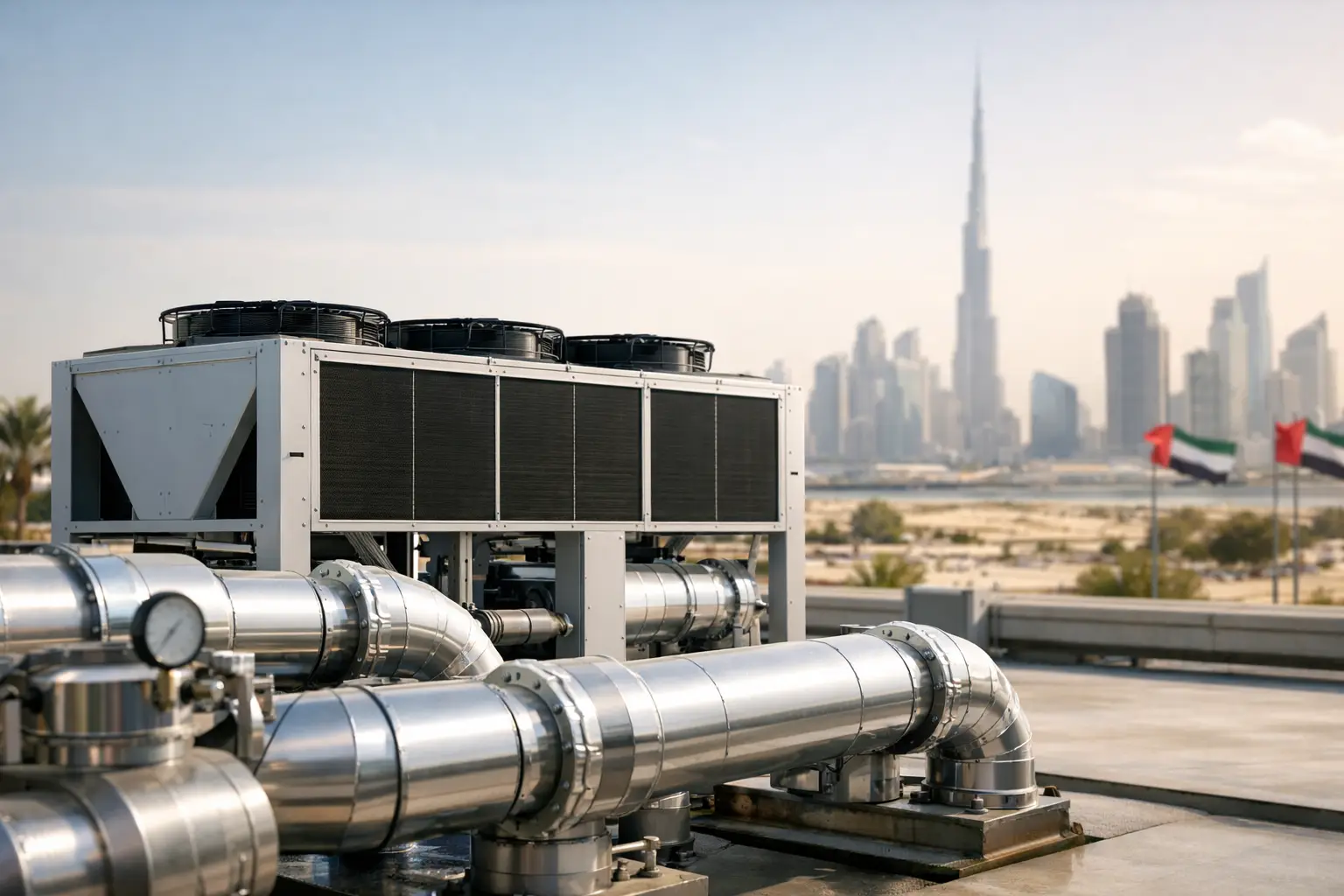
For industrial plants, healthcare applications, commercial buildings, pools, and cold storage support systems, chiller sizing depends on heat load, operating conditions, ambient temperature, flow rate, and the stability the application requires. In the UAE and wider GCC, ambient conditions make this even more critical. A unit that looks acceptable on paper at mild conditions can underperform badly in peak summer if the design assumptions are wrong.
What size chiller needed really depends on
The first number most buyers look for is tonnage or kW. That matters, but it is only one part of the selection. Engineers start proper sizing by calculating the actual heat load they must remove from the water or process fluid over time.
Engineers calculate the load using flow rate, temperature difference, and fluid properties. f a process circulates a certain volume of water and requires a specific temperature reduction, engineers can calculate the required cooling capacity. That is the engineering basis for selecting the chiller. Then the design team checks whether the machine can still deliver that capacity at the real site conditions.
A few details change the answer quickly. If the same production line runs only part of the day, the load profile is different from a continuous 24-hour process. Processes that generate sudden heat spikes may require a buffer tank. If operators use glycol instead of water, the required capacity changes. If the site is in Dubai, Abu Dhabi, Sharjah, or another high-ambient area, Engineers should carefully evaluate condenser performance and derating.
The data needed to size a chiller correctly
A reliable sizing exercise usually starts with five practical questions. Which fluid requires cooling? Required inlet and outlet temperatures? Expected circulation flow rate? Maximum ambient temperature around the unit? Is the load constant or variable?
For comfort cooling or general building applications, engineers may also review occupancy, ventilation, equipment heat, lighting load, and solar gain. For process cooling, the focus is different. Machine heat rejection, batch timing, tank size, exchanger performance, and product temperature limits often matter more than room conditions.
This is why two facilities with similar floor area can need very different chiller capacities. A packaging factory with heat-sealing machines may need far more process cooling than a warehouse of the same size. A dialysis installation may need precise water temperature stability even though the total load is modest. A villa swimming pool may have a large water volume but a slower temperature pull-down requirement than an industrial process.
Common applications and how sizing changes
Industrial process cooling
In manufacturing, the question is not only what size chiller needed, but how stable the process temperature must be. Injection molding, packaging, food processing, and equipment cooling all place different demands on the system.
For example, a packaging line may reject heat from sealing equipment, compressors, hydraulic systems, or molded components. If that line runs continuously, the chiller must match the full production load with margin for summer conditions. If expansion is expected, future load should be considered early so the system does not become undersized in a year.
In one typical factory-style application, the issue is not the chiller alone but the whole loop. Poor pipe sizing, inadequate pump head, or a small buffer tank can make a correctly sized chiller appear ineffective. Good engineering solves the system, not just the equipment selection.
Dialysis cooling applications
Dialysis cooling is a specialized requirement. Temperature control has to be dependable because medical equipment performance and treatment continuity matter more than simple tonnage figures. These projects often require compact, quiet, stable systems designed around real operating conditions rather than generic HVAC assumptions.
For home dialysis and healthcare environments, the load may be smaller than in industrial projects, but the tolerance is tighter. Noise, footprint, maintenance access, and operating continuity are all part of sizing. A slightly oversized or poorly controlled unit can be just as problematic as an undersized one if it creates unstable operation.
Swimming pool temperature control
Pool chiller sizing is often misunderstood. Many people look only at the pool volume. Volume matters, but it is not enough. The required pull-down time, sunlight exposure, pool cover usage, wind, operating season, and whether the pool is residential or commercial all affect capacity.
An outdoor villa pool with full sun exposure in the Gulf will gain heat very differently from an indoor hotel pool. If the owner wants quick temperature reduction before weekend use, the system may need a different capacity than a pool maintained steadily at one target temperature. This is where an engineering-driven load review gives a better answer than a rough estimate.
Commercial and building applications
For commercial cooling, building load calculations usually include occupancy, fresh air, internal heat gains, glazing, orientation, and operating schedule. Here, the chiller should not be chosen by square footage alone. Two office buildings of the same size can have different cooling loads depending on façade design, tenant density, and equipment use.
Why oversizing is not a safe shortcut
Some buyers assume adding extra tonnage is the safest approach. In practice, oversizing can create its own problems. Short cycling increases wear on compressors and controls. Energy use may rise because the machine does not operate efficiently at real load conditions. Temperature stability can also become less precise, especially in low-load periods.
A well-sized chiller should cover the design load with a sensible margin, not an arbitrary one. That margin depends on ambient conditions, expected fouling, operational variability, and future expansion plans. Good selection balances resilience with efficient operation.
What size chiller needed in kW or tons?
Capacity is commonly expressed in kW or tons of refrigeration. One ton of refrigeration equals about 3.517 kW. That helps when comparing quotations or specifications, but it does not replace load calculation.
Consider a system that circulates water at a known flow rate and requires a specific temperature reduction. Engineers can calculate the required heat removal from those operating conditions. After determining the cooling load, they verify the chiller’s rated capacity at the actual entering water temperature and ambient conditions. This step matters because manufacturer ratings can vary based on test conditions. A nominal capacity and a real delivered capacity are not always the same thing.
In high-temperature regions, an air-cooled chiller may need careful derating review. That is one reason project teams should ask for design conditions and performance data rather than only a model number.
Practical mistakes that lead to wrong sizing
One common mistake is using nameplate capacity from old equipment as the only reference. The old unit may already have been oversized, or it may have been failing for years because it was undersized.
Another mistake is ignoring heat added by pumps, motors, product load, or room conditions. In process applications, even small missed loads can push the system beyond its actual capacity. A third mistake is selecting the chiller without reviewing pipework, pumps, tank volume, and controls. Cooling performance is always a system result.
FAQ
Can I size a chiller by room area or pool volume only?
Not reliably. Area and volume can support a rough estimate, but proper sizing needs temperature targets, ambient conditions, heat gains, and operating pattern.
Is a bigger chiller better for future expansion?
Not always. If future growth is real and defined, it can be designed into the system. But oversizing without a clear reason can reduce efficiency and control quality.
Does UAE summer weather affect chiller size?
Yes. High ambient temperatures directly affect air-cooled chiller performance. Capacity should be checked at actual site design conditions, not mild test conditions.
What if my process load changes during the day?
That can be handled through proper controls, staging, variable flow design, or buffer storage. Variable load does not mean guesswork. It means the system should be designed around the real load profile.
How do I know if my current chiller is undersized?
Frequent alarms, inability to reach setpoint, rising process temperatures at peak hours, and nonstop operation during hot weather are common signs. The right next step is a load review, not an immediate replacement with a larger unit.
A properly sized chiller protects production, improves reliability, and gives the operator predictable performance when temperatures are at their worst. If you are planning a new installation or replacing an existing system, AARMOS can review your application, calculate the actual cooling load, and recommend a solution built for your operating conditions, not just a catalog rating. The best results come from getting the size right before the equipment is ordered.
Recent Comments
No comments to show.