June 16, 2026
Aarmos Turnkey Cold Room Project Guide
A cold room usually fails long before it stops cooling. The warning signs show up in product loss, rising power use, frost buildup, unstable temperatures, and constant service calls. That is why a turnkey cold room project guide matters – not as a sales document, but as a practical framework for getting the design, equipment, installation, and support right from day one.
For food processing plants, packaging facilities, pharmaceutical storage operators, and commercial cold storage users across the UAE and GCC, the real question is not whether a cold room can be built. The real question is whether it will hold temperature reliably under your operating conditions, product load, door opening frequency, ambient heat, and future expansion needs. A turnkey approach reduces gaps between design intent and site performance because one engineering team owns the process from load calculation to commissioning.
What a turnkey cold room project guide should actually cover
A proper turnkey cold room project guide starts with application clarity. Not every cold room serves the same duty. A chilled room for fresh produce, a freezer room for meat storage, and a pharmaceutical holding room all require different temperature bands, humidity control priorities, insulation thickness, refrigerant system design, and monitoring logic.
This is where many projects go off course. Many buyers size a room using only the floor area, even though product pull-down, infiltration, occupancy, lighting, and door traffic determine the actual cooling load.
In hot Gulf conditions, outdoor ambient temperature also has a major effect on condensing performance. If engineers underestimate these factors, the room may reach its setpoint during testing but struggle during normal operation.
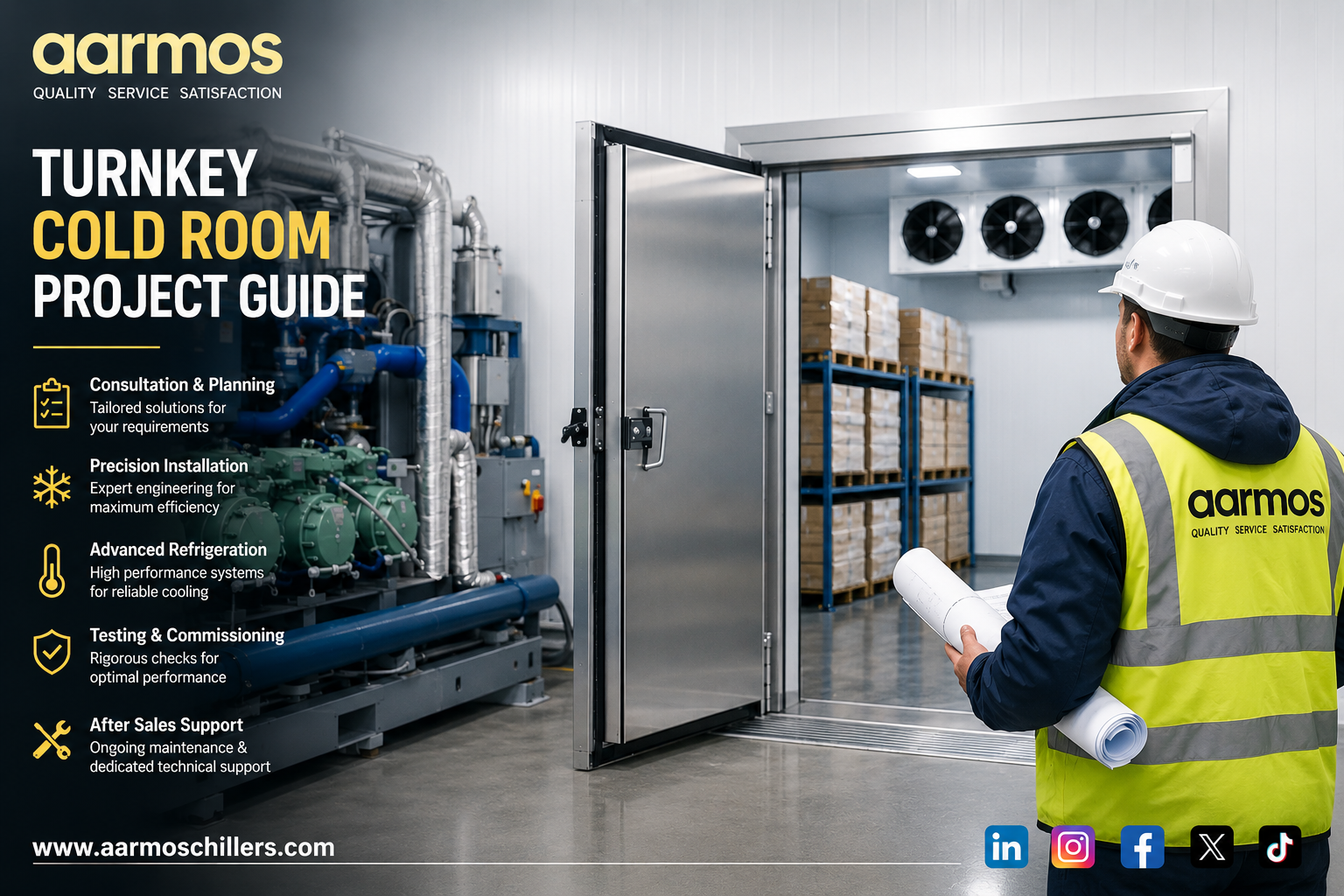
A turnkey project should include a detailed site study and an accurate cooling load calculation. It should also cover layout planning, equipment selection, insulated panel specification, refrigeration piping, electrical coordination, controls, installation, testing, and after-sales support. When project teams treat any of those elements as an afterthought, end users usually pay later through higher energy use and costly downtime.
Start with the operating reality, not just the room size
The best cold room designs begin with a detailed conversation about how the room will be used. Engineers first identify the stored product. They also determine the product entry temperature, daily throughput, door-opening frequency, and whether personnel or forklifts will operate inside the room.
A packaging factory storing temperature-sensitive materials has different needs than a seafood distributor receiving warm incoming loads. A medical application may prioritize tighter temperature stability and alarm integration, while a warehouse may care more about storage density and fast recovery after door openings. There is no single standard design that suits all projects.
In one typical industrial scenario, a customer may request a 0 degree C to 5 degree C cold room for processed food holding. On paper, the space looks modest. But if the room receives multiple daily product batches and the door remains open during pallet transfer, the evaporator capacity, air throw, and condensing unit selection must account for those real conditions. Otherwise, the room temperature drifts every afternoon when the site is at peak activity.
Cooling load calculation is where project quality is decided
The engineering value in a turnkey project is often hidden in the calculations. Cooling load is not just a single number. It is the sum of transmission load through panels, product load, fresh air infiltration, internal heat from people and lights, fan motor heat, and equipment safety margin.
In UAE and GCC conditions, panel insulation and door design have a stronger impact than many clients expect. Poor sealing, undersized insulation, or badly detailed floor interfaces can create continuous heat gain. That forces compressors to run longer, increases frosting risk, and shortens equipment life.
A well-prepared design also considers pull-down time. Some operations need to maintain stored goods at a steady temperature. Others need to reduce product temperature quickly after production or receipt. Those are different duties and may require different evaporator selection, air circulation strategy, or even separate staging areas.
Equipment selection should match the duty, not just the setpoint
A cold room is more than insulated panels and a condensing unit. The refrigeration system, evaporator coil, expansion control, defrost method, control panel, alarm system, and room accessories all affect reliability.
For medium-temperature cold rooms, air-cooled condensing units are often a practical choice in many commercial and industrial sites. But the final decision depends on ambient conditions, maintenance access, noise limitations, and site layout. Evaporator selection also matters. A coil that is too small may lead to poor air distribution and longer run time. A coil that is too aggressive may dry out stored products or create uneven conditions.
Door type is another example of a detail with major operational impact. Hinged doors may work well for low-traffic applications. Sliding doors are often better for pallet movement and wider openings. Strip curtains or air curtains can help reduce infiltration, but their value depends on traffic pattern. It depends on how the room is actually used, not what looks good on a drawing.
Installation quality determines long-term performance
Even a strong design can be undermined by poor installation. Panel joints must be aligned and sealed correctly. Refrigeration piping must be routed and supported properly. Drain lines need correct slope and insulation. Electrical connections and control interlocks should be neat, documented, and tested under operating conditions.
In turnkey cold storage work, coordination is often the hidden challenge. The civil team, electrical contractor, refrigeration technicians, and site operations staff all influence the outcome. If the project team does not manage sequencing carefully, delays and rework follow. That is one reason many industrial clients prefer an engineering-led provider rather than a general trader supplying components from different sources.
At this stage, project documentation also becomes important. Actual panel thickness, condensing unit model, evaporator capacity, refrigerant type, control settings, and test readings should be recorded. Every project should become a case study internally because those records improve service response and future project planning.
Testing and commissioning should reflect real site conditions
A meaningful commissioning process is more than switching the system on. The room should be tested for pull-down performance, temperature stability, control response, defrost operation, drain performance, and alarm functionality. If possible, tests should reflect realistic loading and door activity rather than empty-room conditions only.
For example, a room may hold setpoint perfectly overnight when doors stay closed. But if temperature rises too far during loading periods, the issue may be insufficient evaporator capacity, weak airflow, poor door management, or incorrect control settings. That is why field commissioning needs practical engineering judgment, not a checklist alone.
In one location-based project environment such as Dubai or Abu Dhabi, rooftop heat exposure and condenser airflow restrictions can also affect final performance. Those site realities should be addressed before handover, not after the customer starts facing complaints from their operations team.
Service planning is part of the project, not an add-on
A cold room project is only successful if it remains stable after handover. Preventive maintenance planning, spare parts readiness, operator guidance, and service response structure should be defined early.
This matters especially for facilities where downtime affects production schedules or product safety. Food processors, healthcare storage users, and industrial manufacturers usually care less about the equipment itself than about avoided disruption. That is why a solution-driven company like AARMOS approaches cold room projects as operating systems, not one-time installations.
Routine checks should include suction and discharge conditions, coil cleanliness, door gasket condition, panel integrity, drain line performance, defrost timing, and control calibration. Small issues caught early are usually inexpensive to correct. Left alone, they become compressor failures, spoiled inventory, and emergency shutdowns.
FAQs
What is included in a turnkey cold room project?
A turnkey project typically includes site assessment, load calculation, design, equipment selection, insulated panel supply, installation, electrical and control work, testing, commissioning, and after-sales support.
How do I know what cold room temperature range I need?
That depends on the product, storage duration, and regulatory requirements. Fresh produce, dairy, frozen foods, pharmaceuticals, and process materials all have different target ranges and humidity needs.
Is a bigger refrigeration unit always better?
No. Oversizing can create short cycling, unstable humidity, and unnecessary power use. Undersizing causes temperature drift and long compressor run time. Correct engineering selection is the goal.
Why does my cold room struggle during busy hours only?
That usually points to real operating load issues such as frequent door opening, warm incoming product, poor airflow, or insufficient capacity under peak conditions.
What should I ask before approving a cold room project?
Ask for cooling load basis, design temperature, insulation specification, equipment data, control logic, commissioning plan, and maintenance requirements. Those details reveal whether the project has been engineered properly.
If you are planning a new installation or replacing an underperforming system, the right next step is a technical discussion based on your actual operation. Share your room size, product type, target temperature, and site location, and AARMOS can help you evaluate the most practical cold room solution for reliable long-term performance.
Recent Comments
No comments to show.