June 12, 2026
A cooling system usually proves its value on an ordinary day, not on handover day. The real test comes three months later when a production line is under pressure, a dialysis setup needs stable temperature control, or a cold room starts showing fluctuations that put stored goods at risk. That is where reliable after sales cooling support stops being a nice extra and becomes part of the engineering solution itself.
For industrial operators, healthcare providers, facility managers, and project teams, after-sales support is not just about repair calls. It affects uptime, product quality, energy use, equipment life, and how quickly an issue is identified before it becomes a shutdown. In cooling applications, the gap between a minor fault and a costly interruption can be very small.
What reliable after sales cooling support actually means
In practical terms, support after installation should begin with system familiarity. A service team should already know the cooling duty, ambient conditions, control logic, and operating environment of the installed equipment. If a factory process chiller is serving packaging machinery in a high-load environment, the support approach should be different from a villa pool chiller or a dialysis cooling unit in a home care setting.
Reliable after-sales support affects uptime, product quality, energy use, equipment life, and how quickly teams identify issues before they become shutdowns.
Effective service structures support around real operating conditions, allowing technicians to check refrigerant behavior, water flow, control settings, heat exchange performance, and load variation instead of treating every complaint as a generic service call.
That matters because cooling systems are application-specific. A 10 TR air-cooled chiller serving process equipment has different performance priorities than a low-temperature cold room condensing system or a temperature-control unit for medical use. The support model has to reflect that technical reality.
Why after-sales support matters more than equipment alone
A well-built unit is only one part of long-term performance. Installation quality, commissioning accuracy, operating discipline, and service response all influence results. Even a dependable chiller can underperform if technicians neglect condenser coils, ignore water quality, allow flow rates to drift, or fail to calibrate controls to actual load conditions.
Buyers should consider reliable after-sales cooling support during equipment selection rather than waiting until a problem appears. Buyers often compare technical specifications such as cooling capacity, compressor type, power supply, and design temperature. Those are necessary checks. But they do not answer an equally important question: who will support the system when the site is live and operating pressure is real?
Delayed support can lead to production losses in factories. Cold storage operators may face compromised inventory when cooling issues persist. In dialysis cooling applications, support quality directly affects comfort, consistency, and confidence in the setup.
Reliable after sales cooling support in real operating environments
Consider an industrial process cooling application in a packaging facility. The site may run long hours, with heat loads changing as machinery ramps up and down. If chilled water temperature starts drifting, the reason might not be a major component failure. It could be fouled coils, reduced water circulation, a control sensor issue, or an incorrect setpoint introduced during site adjustments. A responsive service team with commissioning records and system knowledge can diagnose this much faster than a general technician approaching the unit without context.
The same principle applies in food processing or cold storage applications. A cold room may technically be running, yet still fail operationally if pull-down time is too slow or door-opening conditions are not considered. Good after-sales support does more than restore operation. It checks whether the system is performing as intended for the actual use case.
In healthcare-related cooling, the expectation is even higher. Dialysis cooling solutions require stable and dependable operation, because temperature inconsistency can affect user comfort and confidence. Support in this segment should include careful troubleshooting, clear communication, and practical guidance for ongoing use. Engineering matters, but so does responsiveness.
What strong support looks like on the ground
Reliable support is visible in details. Reliable support starts with proper commissioning records, operating parameters, and a service history that technicians can reference during maintenance or troubleshooting. Preventive visits should check system pressures, electrical values, water temperatures, flow conditions, and controller status before a failure occurs.
Strong support also includes realistic advice. Not every issue requires a major intervention, and not every symptom points to the same fault.
It also includes realistic advice. Not every issue needs a major intervention, and not every symptom points to the same fault. A trustworthy cooling partner explains whether the problem comes from the chiller itself, the hydraulic circuit, site ventilation, scaling, dirty heat exchangers, control settings, or external operating conditions.
This distinction is important because customers do not only need fast attendance. They need correct diagnosis. A quick but inaccurate service response can waste time, increase downtime, and leave the root cause untouched.
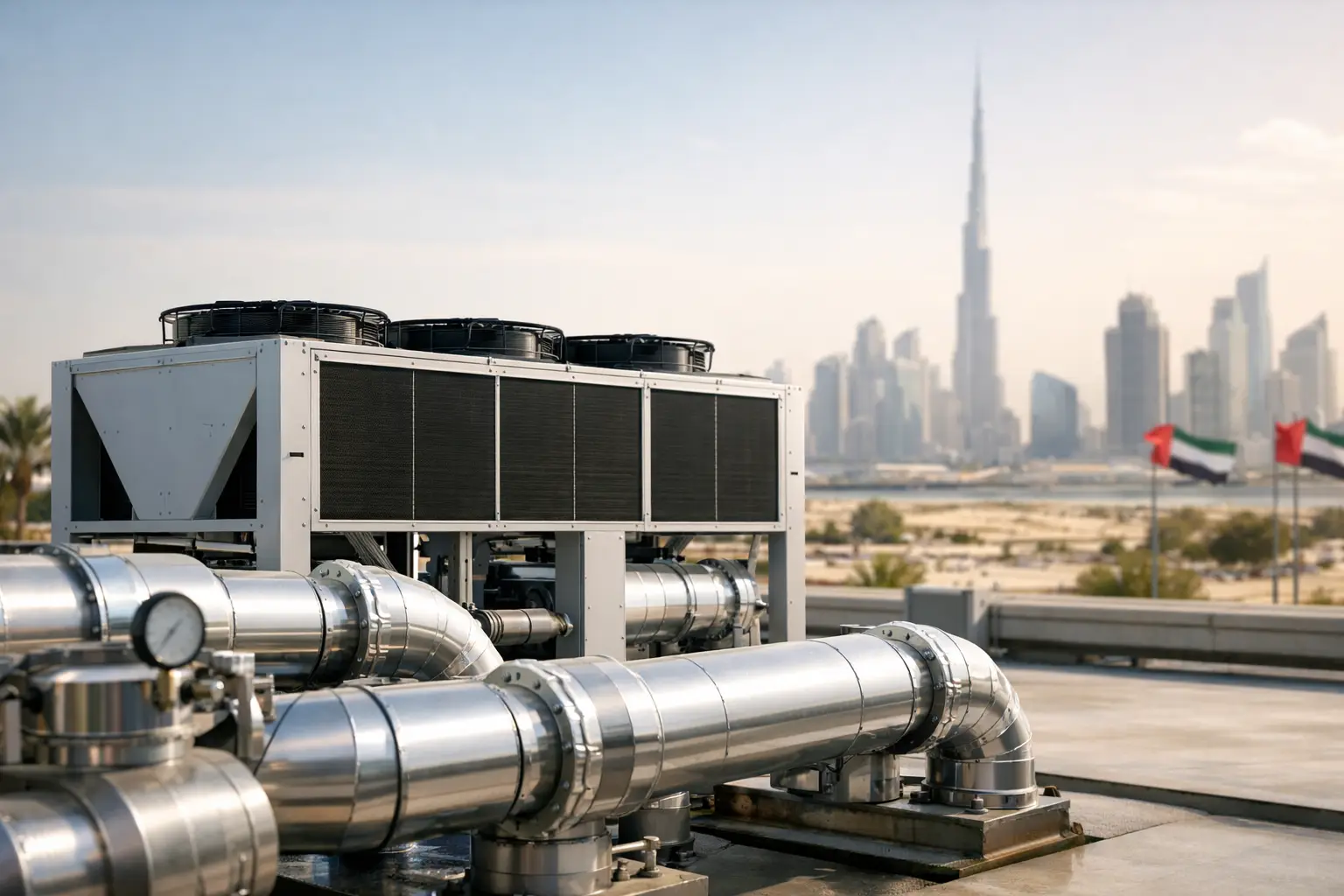
For many sites across the UAE and GCC, ambient conditions add another layer of complexity. High summer temperatures, dust exposure, and variable site maintenance standards can all affect air-cooled equipment. Support teams must account for that. Service planning in Gulf conditions should not copy assumptions from mild-climate installations.
The trade-off between lowest upfront cost and long-term reliability
Many buyers have faced the same problem: a system looks acceptable on paper, performs well at startup, and then becomes difficult to maintain because support is fragmented or slow. The initial decision may save money at procurement stage, but the operating cost appears later through downtime, repeated fault calls, unstable temperature control, and shortened equipment life.
That does not mean every customer needs the most complex support package. The right level depends on the application. A commercial comfort cooling requirement is different from a process-critical industrial line. A residential pool system needs a different response model than a medical cooling setup. But in all cases, dependable support reduces uncertainty.
This is where engineering-led service has an advantage. When the same company understands load calculations, equipment selection, installation conditions, and service behavior, support becomes more practical. The conversation shifts from general complaint handling to performance management.
Questions to ask before choosing a cooling partner
A buyer should ask how the supplier handles commissioning records, preventive maintenance, fault response, and spare part planning. It is also worth asking whether technicians understand the specific application, not just the product category. A process cooling system for manufacturing should be supported by people who understand process stability. A cold room should be supported by people who understand temperature retention, evaporator behavior, and site usage patterns.
Another useful question is how service teams approach recurring faults. If the answer is limited to part replacement, the support may be reactive rather than diagnostic. Good after-sales support looks at causes, trends, and system interaction.
Project teams should also check whether the provider can support future changes. Cooling requirements often evolve. Production lines expand. Storage volumes increase. Site layouts change. A support partner who already understands the installed base can help adapt the system more efficiently.
FAQs
What is included in reliable after sales cooling support?
It usually includes commissioning follow-up, preventive maintenance, troubleshooting, technical guidance, performance checks, and repair support. The exact scope depends on the type of system and how critical the application is.
Why is after-sales support important for industrial chillers?
Industrial chillers often work under continuous or variable load. Small issues in flow, controls, condenser cleanliness, or refrigerant performance can quickly affect production. Proper support helps prevent that from turning into downtime.
Does after-sales support matter for dialysis cooling systems?
Yes. Dialysis cooling applications require stable temperature control and dependable operation. Support should be responsive, technically informed, and suited to the sensitivity of the application.
How often should cooling equipment be serviced?
It depends on the application, running hours, ambient conditions, and equipment type. Sites with heavy duty operation, dust exposure, or critical temperature requirements usually need more frequent checks than light-use installations.
Can after-sales support improve energy efficiency?
Yes. Poor airflow, fouled heat exchangers, incorrect settings, scaling, and control drift can all increase power consumption. Regular technical service helps the system operate closer to design conditions.
Reliable after sales cooling support is not a separate service sitting outside the equipment. It is part of whether the system truly works over time, under pressure, and in real site conditions. For customers who depend on cooling performance rather than just cooling ownership, that difference matters. If you are planning a new installation or need better long-term support for an existing chiller, cold room, pool system, or dialysis cooling setup, contact AARMOS to discuss the application, the operating conditions, and the service structure that will actually protect performance.
Recent Comments
No comments to show.