June 19, 2026
Air Cooled Chiller vs Water Cooled Chiller
When a factory line overheats in July, or a building starts struggling to hold setpoint in peak Gulf conditions, the question of air cooled chiller vs water cooled chiller stops being theoretical. It becomes an engineering decision with direct impact on uptime, energy use, service access, and long-term operating reliability.
For project managers, MEP contractors, facility teams, and industrial operators, the right answer depends less on product preference and more on application. Cooling load, ambient conditions, available utilities, water quality, installation space, maintenance capability, and future expansion all matter. A chiller should fit the site and the process, not the other way around.
Key Differences Between Air-Cooled and Water-Cooled Chillers
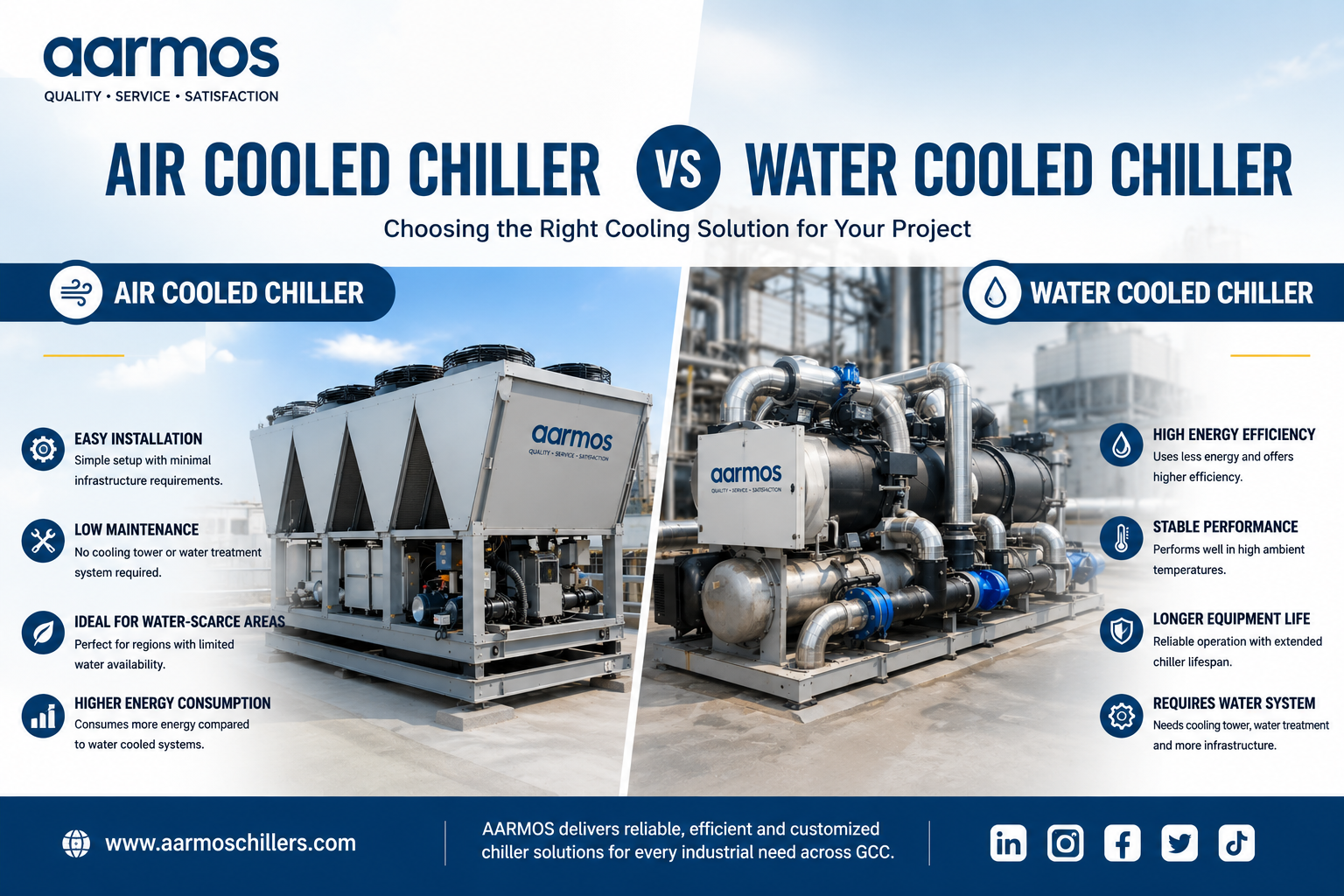
An air-cooled chiller rejects heat directly to outdoor air through condenser coils and fans. Manufacturers typically package air-cooled chillers as self-contained units, and installers usually place them on roofs, slabs, or service yards. This design works well when plant room space is limited or when projects require straightforward installation.
A water-cooled chiller rejects heat to a water loop that usually connects to a cooling tower. Instead of relying on ambient air alone at the chiller, it uses condenser water to transfer heat away from the system. This design is common in larger buildings, industrial plants, and applications where energy performance and capacity stability justify the extra infrastructure.
That difference sounds simple, but it changes everything from layout and piping to maintenance planning and seasonal efficiency.
Where air-cooled chillers make more sense
Air-cooled chillers are often the practical choice for projects that need reliable cooling with fewer supporting systems. Air-cooled systems do not require a cooling tower or condenser water pump. They also eliminate tower water treatment. As a result, installation is faster and less complex.
For villas, small commercial buildings, some medical applications, modular process cooling systems, and retrofit projects, this simplicity is a real advantage. Many UAE and GCC projects prioritize water conservation. In these situations, engineers often choose air-cooled systems because they eliminate cooling tower maintenance.
For example, a packaging unit with a moderate process load may prefer an air-cooled process chiller because it can be placed close to production, connected quickly, and maintained by a smaller technical team.
This type of system is also useful for specialized cooling applications. In dialysis cooling, for instance, a properly selected air-cooled water chiller can provide stable water temperature control without requiring a large central plant arrangement. That matters when equipment reliability and service accessibility are critical.
The trade-off is that air-cooled chillers usually operate at higher condensing temperatures, especially during very hot weather. In peak summer ambient conditions, efficiency can drop compared with a well-designed water-cooled plant.
Where water-cooled chillers have the edge
Water-cooled chillers are often the best choice for large cooling loads. They also perform well in applications with long operating hours where lifetime energy efficiency is important. Commercial towers, hospitals, manufacturing facilities, food processing plants, and institutional buildings often benefit from water-cooled chillers. These systems usually deliver higher efficiency than air-cooled units under heavy, continuous loads.
Condenser water removes heat more effectively than hot outdoor air. As a result, water-cooled chillers maintain stronger performance in demanding environments. This can be valuable in process cooling applications where temperature stability directly affects product quality, machine life, or production output.
Consider a factory running around the clock. Processes such as extrusion, packaging, food production, and chemical handling often require tight temperature control. In these situations, a water-cooled chiller plant can reduce energy consumption and provide more stable long-term operation. The additional complexity of cooling towers, pumps, controls, and water treatment is often justified by higher efficiency and improved plant reliability.
The challenge is that water-cooled systems demand more engineering discipline. Water quality, scaling, fouling, pump performance, tower health, and maintenance access all influence actual performance. A highly efficient system on paper can lose that advantage quickly if maintenance standards drop.
Efficiency is not just about the chiller
Many buyers compare only the nameplate or catalog value when evaluating air-cooled and water-cooled chillers. That approach often leads to the wrong decision. Real efficiency depends on the total system.
An air-cooled chiller may have a higher energy input per ton than a water-cooled machine, but the system is simpler. There are no condenser water pumps and no cooling tower fan energy to include. On some projects, especially smaller ones, that matters.
A water-cooled chiller may deliver better full-load and part-load efficiency. However, the complete plant also includes pumps, tower fans, basin controls, and water management.
If the cooling tower is poorly maintained, condenser approach temperatures rise and expected savings shrink.
That is why cooling load calculation and plant design matter more than broad assumptions.
Engineers should evaluate operating hours, ambient conditions, load diversity, redundancy requirements, and maintenance capability before recommending a system.
Space, utilities, and site conditions
Space often decides the issue before efficiency does. Air-cooled chillers need outdoor space with proper airflow clearance. If the roof is crowded, the service yard is tight, or noise control is sensitive, placement becomes a serious design factor.
Water-cooled chillers reduce the size of outdoor chiller equipment, but they need indoor plant room space plus cooling tower location, pipe routing, pumps, and water treatment provisions. In high-rise or large campus projects, this can be planned from the start. In retrofits, it can be difficult.
Water availability also matters. A water-cooled system relies on make-up water and proper water treatment. In some facilities, this is acceptable and well managed. In others, it becomes an operational burden.
Local climate matters too. In hot regions, air-cooled systems work reliably when selected correctly, but they need careful derating review, condenser airflow planning, and coil maintenance. Water-cooled systems can better handle harsh ambient conditions, but only if the tower and water circuit are managed properly.
Maintenance realities on site
Maintenance is where many selection decisions prove right or wrong.
Air-cooled chillers are generally easier to maintain because they have fewer external support components. Typical service includes condenser coil cleaning, fan and motor checks, refrigerant circuit inspection, water-side maintenance on the evaporator loop, and controls verification. For many facilities, this is manageable with scheduled preventive maintenance.
Water-cooled chillers require a more disciplined maintenance program. In addition to the chiller itself, the cooling tower, condenser tubes, pumps, valves, strainers, and water treatment program all need attention. If scaling or biological growth is not controlled, heat transfer suffers and component life can shorten.
This does not mean water-cooled systems are less reliable. It means they reward good facility management and punish neglected upkeep more quickly.
Application-based selection matters most
For small to medium commercial projects, villas, swimming pool temperature control, and modular process systems, air-cooled chillers are often the cleaner solution. They reduce installation complexity and can still provide dependable performance when properly sized.
For large commercial buildings, industrial facilities with continuous operation, and sites where central utility infrastructure already exists, water-cooled chillers often make more engineering sense. They can support larger loads efficiently and perform well under demanding duty cycles.
A recent project approach often starts with the customer problem, not the machine type. If a food processing facility is facing product inconsistency from unstable process temperature, the solution starts with load profile, process temperature band, redundancy expectations, and sanitation environment. If a dialysis application requires stable cooling with low disruption and straightforward service access, simplicity and reliability may carry more weight than central plant efficiency.
That is why experienced chiller selection includes site review, load calculation, equipment matching, and support planning after installation.
FAQ
Which is better in hot weather, air-cooled or water-cooled?
Water-cooled chillers usually hold efficiency better in extreme ambient conditions because they reject heat through condenser water and a cooling tower. Air-cooled chillers can still perform well in hot climates, but equipment selection and heat rejection design become more critical.
Is an air-cooled chiller easier to install?
In most cases, yes. Air-cooled chillers are simpler because they do not require a cooling tower and condenser water loop. That usually reduces installation scope, plant room requirements, and supporting equipment.
Does a water-cooled chiller need more maintenance?
Yes. The chiller plant includes tower maintenance, water treatment, pumps, and condenser-side cleaning. The extra work can be worthwhile on larger projects where efficiency and capacity justify the plant setup.
Which chiller is better for industrial process cooling?
It depends on process load, operating hours, temperature stability, and site infrastructure. Smaller or standalone processes often suit air-cooled chillers, while larger continuous-duty operations may benefit from water-cooled systems.
Which option is better for long-term value?
Long-term value depends on more than efficiency. Energy use, maintenance resources, downtime risk, water availability, installation constraints, and service response all affect lifecycle performance.
The best chiller decision is rarely made from a brochure comparison. It comes from understanding the site, the load, and the consequences of failure. For facilities across the UAE and GCC, that means choosing a cooling system that can perform in real conditions, be maintained properly, and support the customer long after commissioning. If you are evaluating a new project or replacing an underperforming system, AARMOS can help assess the load, compare options, and recommend a practical cooling solution built around quality, service, and satisfaction.
Recent Comments
No comments to show.