July 4, 2026
When a production line overheats, a dialysis machine room struggles with ambient temperature, or a villa pool becomes unusable in peak summer, the question is not whether cooling matters. The real question is which of the best water chiller applications actually fit the load, operating conditions, and reliability demands of the site. That is where engineering matters more than catalog specifications.
A water chiller is not one product for one industry. It is a temperature control solution that can be adapted for industrial process cooling, healthcare environments, commercial buildings, cold storage support, and residential comfort applications. The right result depends on cooling load calculations, entering and leaving water temperatures, ambient conditions, pump sizing, control strategy, and service access. In the UAE and across the GCC, those details become even more critical because high ambient temperatures punish poorly selected systems.
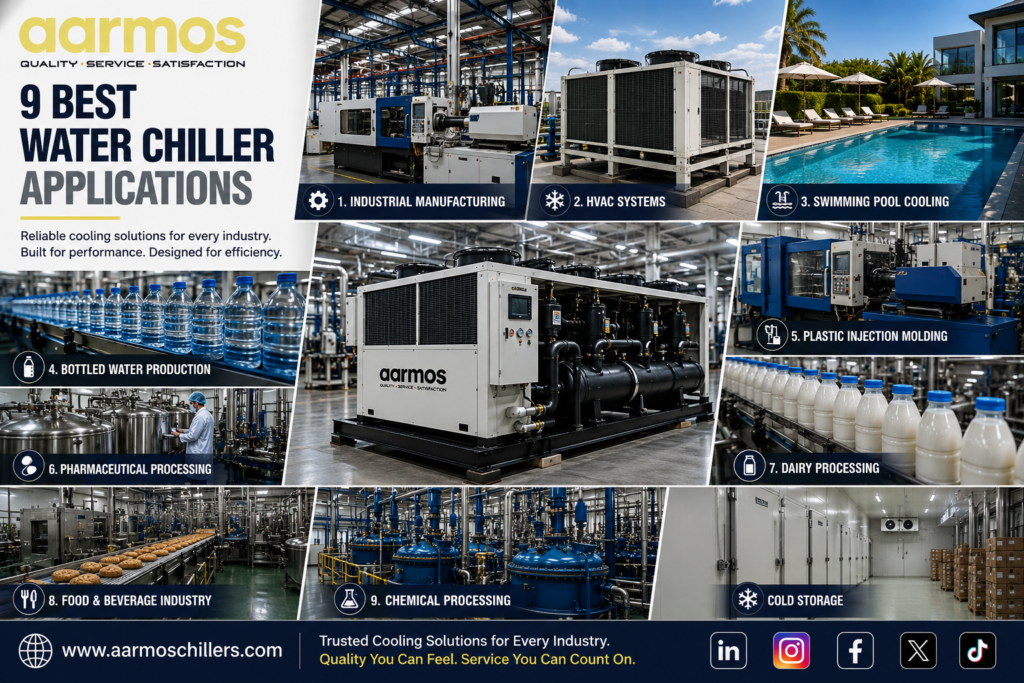
Best water chiller applications in real projects
The best water chiller applications are usually the ones where temperature stability directly affects product quality, equipment life, process uptime, or end-user comfort. Some installations are continuous duty and unforgiving. Others are seasonal but still require dependable performance during extreme heat.
Industrial process cooling
Industrial process cooling is one of the strongest applications for water chillers because process heat is predictable, measurable, and costly when left unmanaged. Packaging factories, plastic processing lines, printing operations, and production machinery often generate heat that must be removed consistently to maintain output quality.
In a packaging facility, for example, excessive process temperature can distort materials, affect sealing quality, and increase rejection rates. A properly sized air-cooled water chiller can circulate chilled water to heat-generating equipment and keep production within target parameters. This improves consistency and reduces machine stress. In practical terms, that means fewer stoppages, better product finish, and more stable production planning.
This is also an application where undersizing creates immediate problems and oversizing creates efficiency penalties. Good design looks at peak load, part-load operation, water flow, and future expansion. For factory managers, that balance matters more than simply choosing the biggest unit available.
Dialysis machine cooling
Dialysis cooling is a specialized application where reliability and temperature control are tied to healthcare performance. In home dialysis and certain medical support environments, water temperature can rise beyond the acceptable operating range for dialysis equipment, especially in hot climates or rooms with limited ventilation.
A dedicated cooling solution helps maintain the water supply temperature required by the dialysis machine. This protects treatment continuity and reduces the risk of machine alarms or interruptions caused by heat. For patients and caregivers, the value is practical and immediate – more stable operation, fewer heat-related disruptions, and greater confidence in day-to-day use.
This type of application also requires careful attention to noise, footprint, operating simplicity, and maintenance access. It is not just about cooling capacity. It is about designing a system suitable for a sensitive environment where reliability comes first.
Food processing and beverage production
Food processing is another of the best water chiller applications because temperature directly influences hygiene control, product quality, and process timing. Chillers are used to cool mixers, process lines, ingredient tanks, and production equipment where excess heat can affect taste, texture, shelf life, or throughput.
In beverage production, stable cooling can support filling operations and help maintain consistent product conditions. In food preparation areas, process cooling can limit heat buildup around critical equipment. The trade-off here is that the chiller system must be matched to sanitation requirements, operating schedules, and washdown conditions. A general-purpose unit may not be enough if the environment is aggressive or the process load fluctuates sharply.
Cold rooms and temperature-sensitive storage support
Cold rooms rely on refrigeration systems, but water chillers can play an important supporting role in temperature-sensitive operations, especially where process areas, packing zones, or pre-cooling stages need controlled conditions before products enter storage. For facilities handling food, pharmaceuticals, or sensitive materials, that transition area is often where temperature losses begin.
A well-designed cooling system helps maintain stable upstream conditions and reduces thermal stress on storage operations. This is particularly useful in facilities where doors open frequently, product turnover is high, or ambient heat is severe. In these cases, the cooling strategy is broader than the cold room itself. It includes the process around it.
Commercial buildings and specialized zones
Commercial water chillers are commonly used in buildings, but the most effective applications are often not the largest ones. They are the spaces with clear and demanding cooling needs – technical rooms, equipment rooms, laboratories, server areas, and high-occupancy zones where standard comfort cooling is not enough.
For project managers and MEP contractors, this is where chilled water systems offer flexibility. They can be integrated into broader HVAC strategies while serving specific zones with controlled temperatures. The benefit is not just occupant comfort. It is equipment protection and stable environmental performance.
In these projects, pump head, pipe routing, controls integration, and serviceability should be reviewed early. A chiller that looks suitable on paper can become difficult to maintain if installation access is poor or controls are not coordinated with the building system.
Swimming pools for villas, hotels, and resorts
Swimming pool temperature control is one of the most visible applications because users notice the result immediately. In hot climates, pool water can become uncomfortably warm during summer. A pool chiller helps maintain usable water temperature and improves the swimming experience for residential and commercial properties.
For villa owners, the priority is usually comfort, quiet operation, and ease of use. For hotels and resorts, the focus shifts to continuous operation, bather load, circulation rate, and maintenance planning. In both cases, sizing should be based on pool volume, solar exposure, ambient conditions, operating hours, and target water temperature.
This is also an application where expectations need to be managed properly. Cooling a shaded indoor pool is very different from cooling a large outdoor pool exposed to full sun and wind. The desired temperature drop, and how fast that drop is expected, changes the equipment selection significantly.
Plastic, printing, and machinery cooling
Many manufacturing operations use water chillers to protect machinery itself rather than the final product. Injection molding machines, hydraulic systems, laser equipment, and printing machinery all generate heat that reduces precision and accelerates wear if it is not controlled.
The measurable benefit here is often reduced downtime and improved equipment life. Stable operating temperature helps machinery perform more consistently, which can lower maintenance frequency and improve output accuracy. In sectors where one hour of downtime disrupts the whole shift, reliable cooling quickly proves its value.
Laboratories and institutional facilities
Institutional and technical facilities often require cooling for test equipment, controlled processes, or specialized rooms with steady internal heat gain. This category includes labs, educational facilities, research settings, and equipment support spaces.
What makes these projects different is the need for predictable performance rather than maximum capacity alone. Controls, alarms, water quality, and operating stability often matter more than aggressive cooling speed. The best solution is usually the one that fits the operating profile cleanly and remains easy to service over time.
What makes an application a good fit for a water chiller
A site is usually a strong candidate for a chiller when heat is continuous, the required temperature range is clearly defined, and downtime has real operational cost. Water chillers also make sense when air-based cooling alone cannot remove heat effectively from equipment or processes.
That said, not every project needs the same configuration. Air-cooled chillers are often preferred where water availability is limited and installation simplicity matters. Other projects may require customized buffer tanks, circulation pumps, insulated piping, or control panels designed around the process. The application is only as good as the system built around it.
FAQ
Which industries use water chillers most often?
Manufacturing, packaging, food processing, healthcare, commercial facilities, and hospitality are among the most common. The strongest use cases are those where temperature control affects process quality, equipment performance, or user comfort.
Are water chillers suitable for dialysis applications?
Yes, when they are selected specifically for dialysis cooling requirements. The system should be designed around the machine’s operating conditions, room environment, reliability needs, and ease of use.
What is the difference between process cooling and comfort cooling?
Process cooling protects equipment or stabilizes production conditions. Comfort cooling is designed for people and occupied spaces. Some projects combine both, but the design priorities are different.
Can one chiller serve multiple applications?
Sometimes, yes. A properly engineered system can support several loads if flow rates, temperatures, controls, and operating priorities are planned correctly. Shared systems require careful design to avoid performance conflicts.
How do you choose the right chiller size?
Sizing depends on total heat load, required water temperature, ambient conditions, flow rate, run hours, and future expansion. Accurate load calculation is the starting point. Guesswork usually leads to inefficiency or poor performance.
The best water chiller applications are not defined by industry labels alone. They are defined by how well the cooling system solves a real operating problem and keeps doing it under site conditions. If you are planning a process cooling, dialysis cooling, cold storage support, commercial, or pool temperature control project, contact AARMOS for an engineering-led review built around your actual load, environment, and performance goals.
Recent Comments
No comments to show.