June 11, 2026
Chiller Installation and Maintenance Basics
A chiller that is oversized, poorly piped, or left without a maintenance plan rarely fails all at once. It starts with rising power use, unstable leaving water temperature, nuisance trips, and complaints from production, facilities, or end users. Engineers should treat chiller installation and maintenance as one engineering process rather than two separate tasks.
For factories, healthcare environments, commercial buildings, villas, and cold storage applications, The real objective goes beyond placing a machine on site. The objective is to deliver stable cooling under actual operating conditions, with safe installation, correct controls, and a service approach that prevents avoidable downtime. Ambient temperatures, water quality, and operating hours can be demanding in the UAE and wider GCC. For that reason, these details matter even more.
Why chiller installation and maintenance must be planned together
A well-selected chiller can still underperform if the installation ignores hydraulic balance, airflow clearance, electrical protection, or control integration. The opposite is also true. Even a technically sound installation will lose efficiency if technicians do not clean condenser coils, monitor refrigerant conditions, or inspect pumps and sensors regularly.
From an engineering perspective, engineers use installation practices to establish the operating conditions for the equipment. Maintenance preserves them. When teams manage both correctly, they achieve more consistent process temperatures, lower compressor stress, better energy performance, and longer service life.
This is especially relevant in industrial process cooling, dialysis cooling, food processing, packaging lines, and swimming pool temperature control. These applications do not all behave the same way. A packaging factory may face fluctuating daytime loads, while a dialysis cooling setup may need stable temperature control with minimal disruption. The installation and maintenance strategy should reflect that reality.
Key steps in chiller installation
Start with the actual cooling load
Many problems begin before equipment arrives on site. Engineers should calculate the cooling load based on process heat, ambient conditions, operating hours, fluid temperatures, pump requirements, and future expansion plans. A rule-of-thumb selection may look acceptable on paper but create short cycling, poor control, or unnecessary energy use in practice.
For example, an industrial water chiller serving a packaging facility in Sharjah may need to handle continuous production heat during long shifts. A villa pool chiller in Dubai will behave differently because the load changes with sun exposure, pool size, usage pattern, and target water temperature. One size does not fit all.
Prepare the site correctly
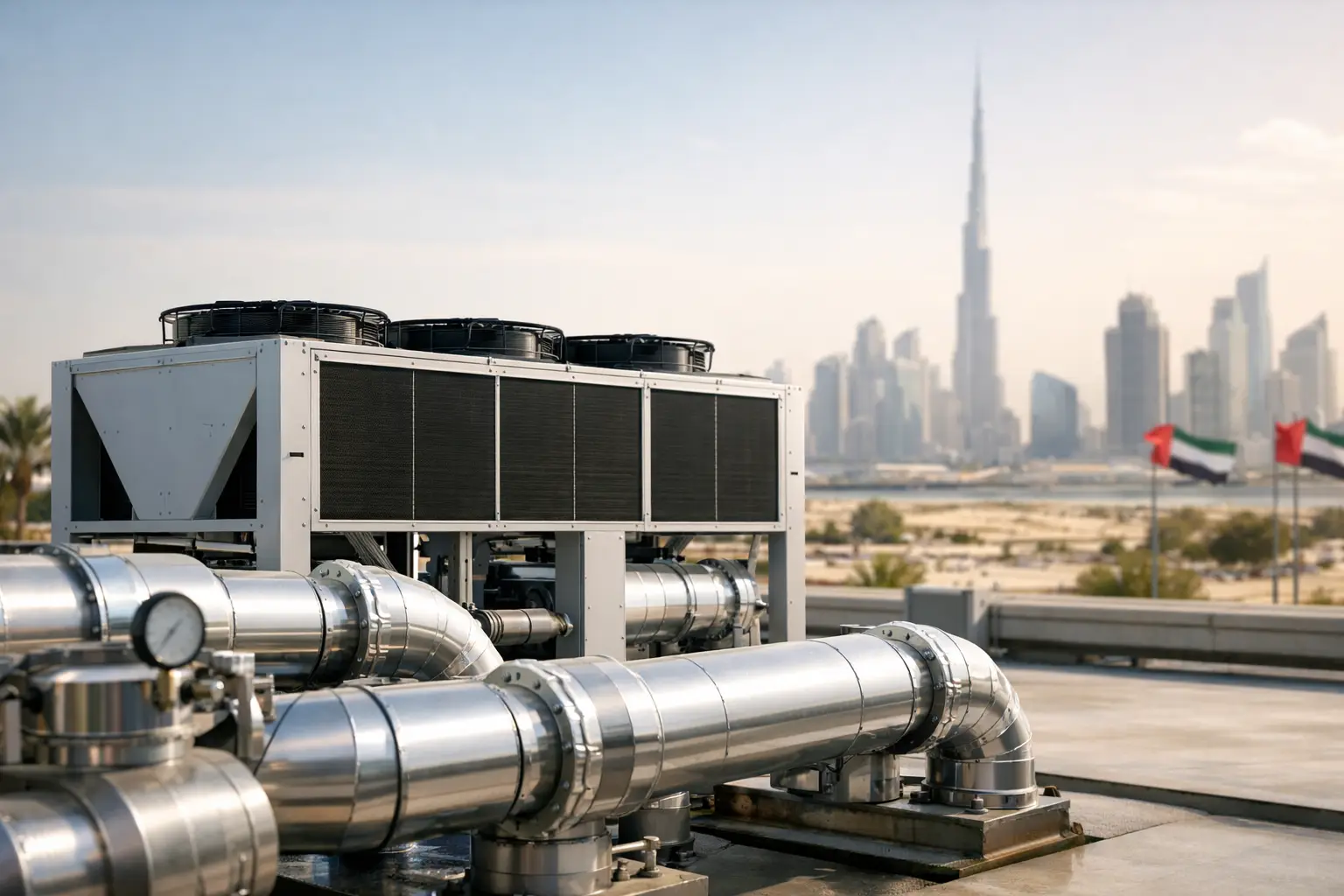
The chiller location affects performance more than many clients expect. Air-cooled chillers need sufficient airflow clearance around the condenser. Restricted air circulation increases condensing temperature and forces the compressor to work harder. Indoor installations require proper ventilation, drainage, service access, and safe lifting routes.
Foundation and mounting also matter. Uneven support can create vibration issues, pipe stress, and premature wear. For process cooling systems, piping layout should minimize pressure drop and allow easy isolation for service. Water treatment, strainers, expansion provisions, and proper insulation are part of a reliable installation, not optional extras.
Get the piping and controls right
A chiller does not operate alone. It works as part of a system that includes pumps, tanks, valves, sensors, control panels, and the end-use equipment. Incorrect pipe sizing or poor control logic can make a good chiller look unreliable.
In a practical installation, engineers should verify flow rate, entering and leaving water temperatures, pressure drop, pump head, and control sequencing. If the application is sensitive, such as dialysis machine cooling or temperature-controlled processing, engineers should review sensor placement and alarm logic carefully.
Stable control depends on accurate feedback.
Commission before handover
Commissioning should confirm more than simple startup. Technicians should check electrical readings, refrigerant pressures, water flow, temperature differential, compressor cycling, safety cutouts, and control response under realistic load conditions. A proper commissioning report gives the customer a technical baseline for future maintenance.
Proper commissioning prevents many long-term issues at this stage. A small wiring error, a dirty line, trapped air in the circuit, or an incorrectly set controller can lead to months of poor performance if not caught early.
What good maintenance looks like in the field
Preventive maintenance is cheaper than disruption
In cooling systems, neglect usually shows up as inefficiency before it becomes a shutdown. Condenser fouling, blocked strainers, low water flow, refrigerant imbalance, sensor drift, and contactor wear often develop gradually. A preventive maintenance schedule catches these issues while the system is still operating.
For air-cooled chillers in dusty or sandy environments, coil cleaning frequency may need to be higher than a standard schedule suggests. In process applications, water quality monitoring can be just as important as refrigerant checks. The right maintenance plan depends on the operating environment, not just the calendar.
The checklist should reflect the application
A commercial building chiller and an industrial process chiller may share core components, but the service priorities differ. Maintaining stable process temperature may be the top concern in industrial cooling. Reliability and alarm response often carry greater weight in healthcare settings. Seasonal pool performance usually depends on heat exchange efficiency and flow conditions.
A practical maintenance visit often includes inspection of compressor condition, condenser cleanliness, evaporator performance, electrical terminals, pump operation, insulation status, sensor calibration, control panel alarms, refrigerant operating pressures, and water flow integrity. The value is not in ticking boxes. The value is in identifying trends before they become failures.
Common installation and maintenance mistakes
Chiller installation and maintenance issues to avoid
One common mistake is selecting capacity based only on nominal tonnage without reviewing actual heat load and operating conditions. Another is installing the unit in a tight space where hot discharge air recirculates back through the condenser. Both can reduce performance immediately.
On the maintenance side, many operators wait for a fault code before calling for service. That approach usually means the system has already been under strain for weeks or months. Ignoring water treatment is another expensive shortcut. Scale, corrosion, and fouling reduce heat transfer and raise energy consumption, even when the chiller itself is mechanically sound.
There is also a control-related issue that gets overlooked. If sensors are inaccurate or control settings are changed without understanding the process, the chiller may appear unstable when the real problem is poor control logic.
A project-focused approach delivers better results
Every project should become a technical reference point. A proper record includes site photos, equipment model details, operating temperatures, load assumptions, commissioning readings, and service history. These records help during troubleshooting, expansion planning, and performance review.
In a real project environment, this approach helps answer practical questions quickly. Was the original flow rate achieved during commissioning? Has condenser approach temperature changed over time? Did the process load increase after new machinery was added? Those answers reduce guesswork.
This is particularly useful for industrial cooling systems in the UAE, where operating conditions can shift with production changes, seasonal heat, and site layout constraints. A measured, documented engineering process gives customers long-term value, not just initial installation.
FAQs
How often should a chiller be serviced?
It depends on the application, environment, and operating hours. A lightly used system may need periodic scheduled inspections, while an industrial or healthcare application may need more frequent preventive maintenance to protect uptime and temperature stability.
What is the most common reason for poor chiller performance?
There is no single answer, but common causes include incorrect sizing, dirty condenser coils, low water flow, poor ventilation around the unit, and lack of preventive maintenance.
Is installation quality really as important as equipment quality?
Yes. Even a reliable chiller can perform badly if it is installed without proper load calculation, piping design, electrical protection, airflow clearance, and commissioning.
Can maintenance reduce energy consumption?
Yes. Clean heat exchange surfaces, correct refrigerant operating conditions, proper water flow, and calibrated controls all help the chiller run more efficiently.
What should be documented after installation?
A useful record includes equipment specifications, site photos, piping and control details, commissioning readings, and maintenance recommendations. That information supports future service and system upgrades.
When chiller work is handled with practical engineering discipline, the outcome is straightforward: more stable cooling, fewer interruptions, and equipment that performs the way it was intended to perform. If your facility, project, or application needs a properly engineered approach to installation, troubleshooting, or preventive service, contact AARMOS to discuss the operating conditions and cooling requirements in detail.
Recent Comments
No comments to show.