July 6, 2026
A production line that runs hot for even one shift can turn a small cooling mistake into scrap, downtime, and missed delivery dates. That is why knowing how to choose industrial chiller equipment is less about buying a machine and more about protecting process stability. In factories, food facilities, medical environments, and packaging plants, the right chiller is the one that matches the real load, site conditions, and operating priorities – not just the nameplate capacity.
Why chiller selection goes wrong
Most sizing problems start with one assumption: if the process needs cold water, any chiller with enough tons will do. In practice, that approach creates trouble. A chiller may be large enough on paper but still struggle because the entering water temperature, ambient temperature, pump arrangement, fluid type, or duty cycle was overlooked.
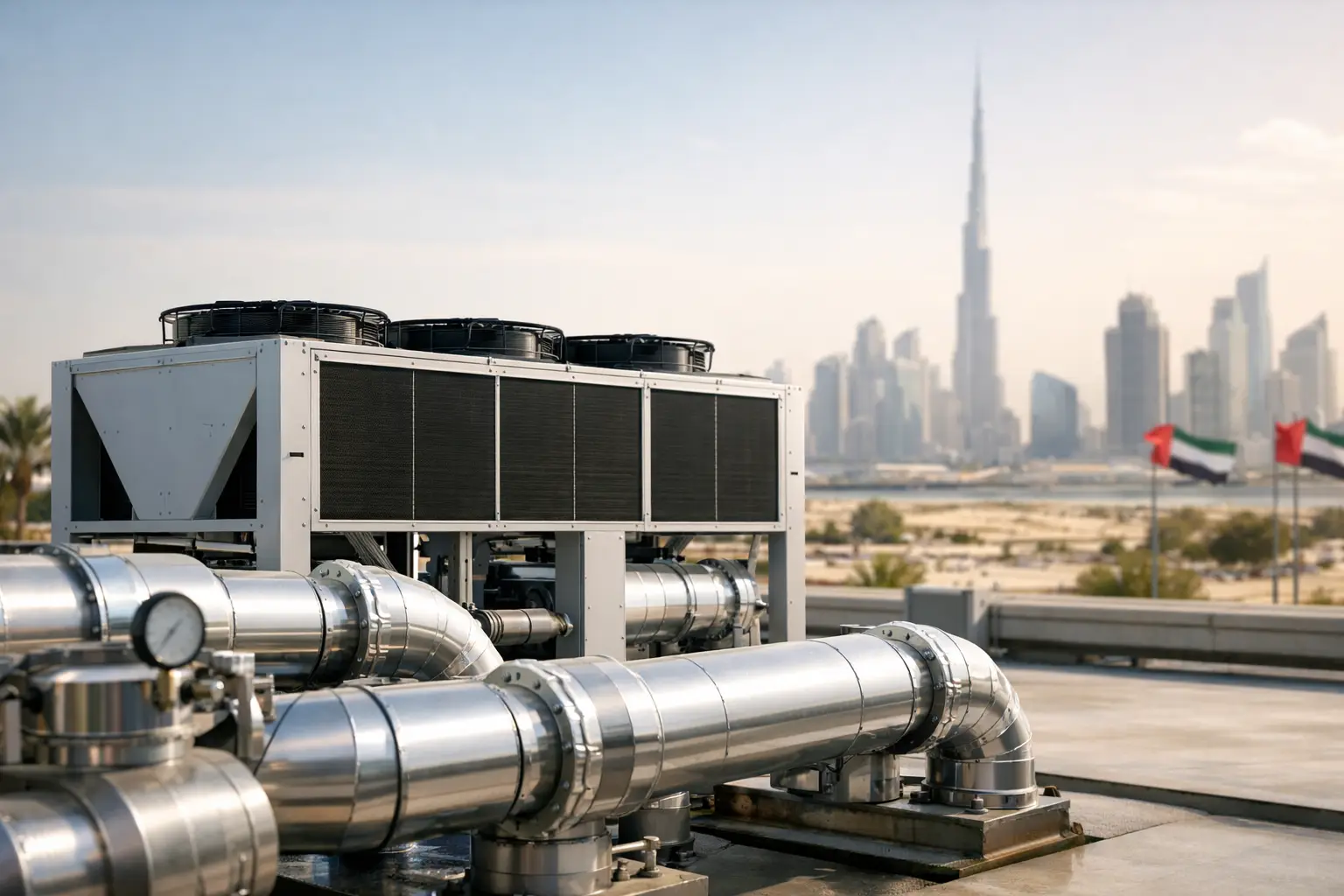
This is common in Gulf conditions, where high ambient temperatures can reduce air-cooled chiller performance if the system was selected using mild-climate data. It also happens when a plant expands in stages and cooling demand changes over time. What looked acceptable during procurement can become a bottleneck once more machines are added or production hours increase.
How to choose industrial chiller capacity correctly
Capacity is the first checkpoint, but it should come from a cooling load calculation, not a guess. The load depends on the heat your process removes, the required leaving water temperature, the return temperature, the flow rate, and whether the load is steady or fluctuating.
For example, a packaging line may need stable cooling during long operating hours, while a batch process may create short but heavy peaks. If you size only for average demand, the system may trip during peak load. If you oversize too far, the chiller may short cycle, waste energy, and wear components faster.
A proper calculation usually reviews process equipment heat rejection, heat gain from piping and tanks, ambient conditions, and future expansion. In many projects, adding a reasonable safety margin makes sense. Adding an oversized cushion does not. Good engineering is precise, not excessive.
Start with these technical questions
Before selecting a model, define the process in operating terms. What temperature must the fluid supply to the equipment? What return temperature should be expected? How many liters per minute or gallons per minute are required? Will the process run 24/7 or only during certain shifts? Is temperature tolerance tight, such as plus or minus 1 to 2 degrees, or is wider variation acceptable?
Those answers shape the chiller type, compressor staging, controls, and pump package.
Choose the right chiller type for the application
The next step in how to choose industrial chiller systems is deciding between air-cooled and water-cooled designs. For many industrial sites, air-cooled chillers are preferred because installation is simpler and they do not require cooling towers or condenser water treatment. They are practical for factories, commercial facilities, and retrofit projects where space and maintenance resources are limited.
Water-cooled chillers can be more efficient in some larger applications, but the system is more complex. You need condenser water piping, a cooling tower, water treatment, and additional maintenance planning. That trade-off may be worthwhile in large, continuously operating facilities. It may not be the right fit for every plant.
There is also the question of process fluid. If the system uses a water-glycol mixture for freeze protection or low-temperature operation, the chiller, pump, and heat exchanger must be selected accordingly. Glycol changes heat transfer and pump performance. Ignoring that detail leads to underperformance.
Match the chiller to site conditions
Industrial chillers do not operate in a lab. They operate on rooftops, in service yards, beside dusty production halls, or near coastal environments. Site conditions matter.
High outdoor ambient temperatures raise condensing pressure in air-cooled systems and reduce available capacity. Dusty environments may require stronger condenser coil protection and a maintenance plan for regular cleaning. Coastal installations may benefit from anti-corrosion treatment on coils and cabinets. Indoor installations need proper ventilation, service clearance, and noise review.
Power supply is another practical issue. Voltage, phase, frequency, and starting current must match site infrastructure. A technically suitable chiller can still create project delays if the electrical requirement was not confirmed early.
Controls, redundancy, and process stability
In industrial cooling, temperature stability often matters as much as raw capacity. That is especially true in medical and process-sensitive applications. A chiller with poor control logic can create swings that affect product quality, machine performance, or operating safety.
Look closely at the controller, sensors, safeties, and compressor staging. Multiple compressors or inverter-driven systems can improve part-load performance and tighter temperature control, depending on the application. Alarm history, remote monitoring, and BMS integration can also be valuable for plants that need quick troubleshooting.
Redundancy is worth discussing when downtime is expensive. In a dialysis cooling application or a production process with strict uptime requirements, a standby arrangement or N+1 concept may be more important than chasing the lowest first cost. The best choice depends on the consequence of failure.
Do not ignore the hydraulic side
Many chiller issues are not refrigeration issues at all. They are water flow issues. If the pump is not correctly selected, if the tank is too small, or if pipe sizing is poor, the process may see unstable temperatures or low flow alarms even when the chiller itself is healthy.
A complete selection should review the pump head, flow requirement, buffer tank volume, piping layout, and control valves. In process cooling systems, hydraulic design is part of chiller performance. This is where engineering-led suppliers tend to add value because they review the full system, not only the cooling unit.
Energy efficiency is more than a brochure number
Efficiency should be reviewed at actual operating conditions, not only at ideal test points. A chiller that looks efficient at one rating condition may perform differently at your required leaving water temperature and local ambient conditions.
Part-load behavior matters too. Many facilities do not run at full load all day. If your operation ramps up and down, staged compressors or inverter technology may reduce energy use. Still, the most efficient system on paper is not automatically the best option if it is harder to service, more sensitive to site conditions, or mismatched to your control strategy.
The right question is not simply, “Which unit has the best efficiency number?” It is, “Which system gives reliable performance and sensible operating cost for this process?”
Think beyond delivery to service support
A chiller is not a one-time purchase. It is a working asset that needs commissioning, preventive maintenance, and technical support. That is why service capability should be part of the selection process.
Determine who will handle startup, parameter setting, troubleshooting, and spare parts support. Confirm whether the supplier can calculate the cooling load, review the piping design, and verify site readiness before delivery. Also evaluate how quickly the supplier can respond if the production process stops unexpectedly.
In real projects across manufacturing and healthcare environments, the strongest long-term results usually come from suppliers that approach the job as a system responsibility. That means understanding the application, documenting performance targets, and staying involved after installation. For engineering-driven companies such as AARMOS, this is where customer value is created – not just by supplying equipment, but by making sure the cooling solution works reliably in the field.
A practical example of better selection
Consider a process cooling requirement in a packaging facility where seal quality depends on controlled equipment temperature. The initial request may be for a 20 TR air-cooled chiller based on a rough estimate. After reviewing machine heat load, operating hours, ambient conditions, and required water temperature, the actual requirement may point to a different configuration with a buffer tank, circulation pump, and improved control sequence.
The measurable benefit is not only cooling. It can include fewer production interruptions, more stable product quality, lower compressor cycling, and simpler maintenance. That is what good chiller selection looks like in practice.
FAQs
What is the most important factor when choosing an industrial chiller?
Cooling load is the starting point, but it is not the only factor. The correct leaving water temperature, flow rate, ambient conditions, and application sensitivity are equally important.
Should I choose an air-cooled or water-cooled chiller?
It depends on site conditions, maintenance resources, and operating profile. Air-cooled chillers are often simpler and more practical. Water-cooled systems may suit larger facilities where higher system complexity is acceptable.
How much safety margin should be added to chiller capacity?
A modest margin for operating uncertainty and future variation can help. Oversizing too much can reduce efficiency and create control problems. Capacity should be based on engineering calculation, not guesswork.
Can one chiller serve multiple process machines?
Yes, if the hydraulic design, flow balancing, and total load are properly engineered. Shared systems can work well, but they need correct piping, pumping, and control planning.
Why does service support matter so much?
Because even a well-selected chiller needs commissioning, maintenance, and occasional troubleshooting. Fast technical response helps reduce downtime and protects process continuity.
If you are evaluating a new process cooling system, replacing an aging unit, or planning a specialized application such as dialysis cooling, start with the operating conditions and the consequences of getting them wrong. The right answer is usually not the fastest quote. It is the system that fits your process, your site, and your long-term service needs. If you want help reviewing load calculations, application requirements, or chiller options for your facility, contact AARMOS for an engineering-led recommendation.
Recent Comments
No comments to show.