Aarmos Cold Room Installation Company
A cold room that drifts a few degrees off target can ruin stock, interrupt production, or create compliance problems before anyone notices. That is why choosing a cold room installation company is not just a procurement decision. It is an engineering decision that affects product quality, operating cost, uptime, and service response for years after handover.
For food processors, packaging factories, healthcare facilities, and cold storage operators, the real question is not who can supply panels and condensing units. The better question is who can assess the application properly, size the system accurately, install it cleanly, and support it when temperatures, ambient conditions, and operating patterns change in the real world.
What a cold room installation company should actually do
A capable contractor should begin well before installation. The process should start with understanding what is being stored, what temperature range is required, how frequently doors will open, what the ambient conditions are, and whether the room will be used for holding, pull-down, or both. A cold room for dairy products behaves differently from a room used for fresh produce, pharmaceuticals, or packaged goods.
This early engineering stage matters because cold room performance depends on more than equipment capacity. Panel insulation thickness, vapor sealing, air circulation, defrost method, floor construction, and control logic all affect stability and efficiency. If the installation company skips these details, the system may still run, but it may struggle with ice buildup, uneven temperature, high power use, or frequent compressor cycling.
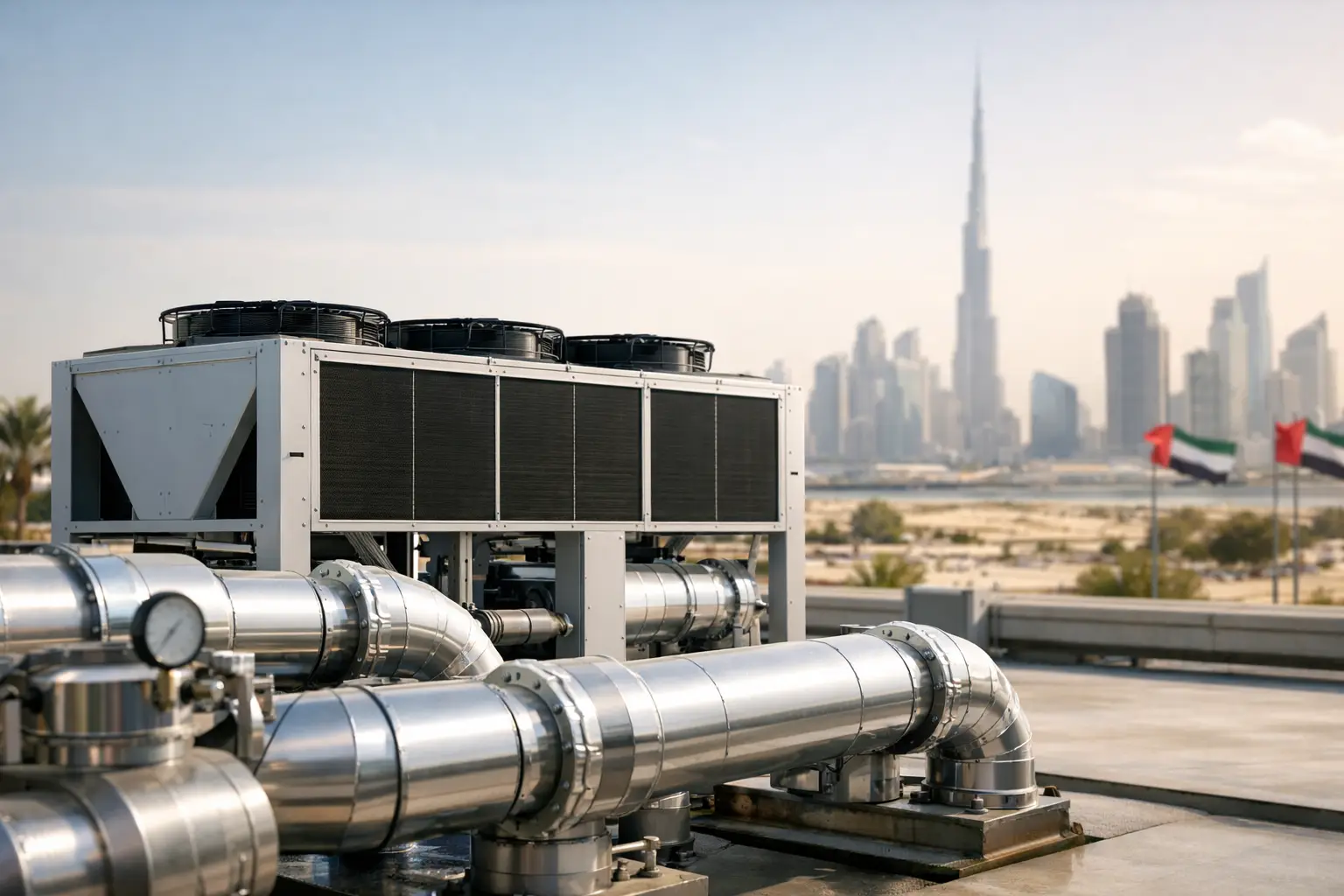
An engineering-focused provider also looks at the full operating environment. In the UAE and across the GCC, high ambient temperatures place extra demand on outdoor condensing equipment. That affects condenser sizing, ventilation requirements, refrigerant performance, and maintenance intervals. A design that looks acceptable on paper in mild weather may underperform badly in peak summer conditions.
Why design accuracy matters more than equipment brand
Many buyers begin by comparing equipment names or asking for a like-for-like quote. That is understandable, but cold room results usually depend more on design accuracy than on the label attached to the condensing unit.
Cooling load calculation is the starting point. A proper calculation should consider room dimensions, insulation values, product load, internal lighting, personnel traffic, door openings, pull-down time, and outside temperature. If the load is underestimated, the room may never recover quickly after loading cycles. If it is oversized, the system may short cycle, waste energy, and reduce component life.
The same principle applies to evaporator selection. A unit cooler should match the room use, humidity profile, and temperature target. In a high-traffic cold room, airflow pattern and coil selection become especially important. Too much air velocity can dry products or create uneven conditions. Too little circulation can create hot spots and poor recovery.
This is where an experienced cold room installation company separates itself from a general trader. The goal is not simply to deliver refrigeration hardware. The goal is to build a working temperature-controlled space that remains stable under actual operating conditions.
Cold room installation company selection for different applications
Not every cold room serves the same purpose, and the installation strategy should reflect that.
For food processing and packaging facilities, hygiene, washdown resistance, temperature recovery, and reliable door sealing are often priorities. These projects may require careful detailing around drains, insulated flooring, and easy-to-clean internal finishes. If production schedules are tight, equipment redundancy or staged cooling may also make sense.
For healthcare and pharmaceutical storage, temperature consistency and monitoring become more critical than raw pull-down speed. Alarm systems, calibrated controls, and dependable backup planning deserve more attention. In these environments, the installer should understand not just refrigeration equipment, but the operational consequences of a temperature excursion.
For commercial
cold storage operators, rack layout, loading patterns, forklift movement, and door usage can shape the room design. A technically sound company will ask how the room will be used day to day, not just how large it needs to be.
For industrial clients, the cold room may be part of a larger process cooling requirement. In these cases, the contractor should understand how the room interacts with upstream production, chilled water systems, or adjacent conditioned areas. Practical engineering matters because one weak link can affect the full operation.
What good installation looks like on site
The installation phase is where design assumptions meet site reality. Good workmanship is not cosmetic. It directly affects thermal performance, moisture control, and maintenance access.
Panels should be aligned correctly, joints sealed properly, and structural supports coordinated with the room size and usage. Refrigeration piping should be routed with correct support spacing, insulation, and oil return considerations. Electrical wiring should be neat, protected, and labeled for future service. Drain lines should be sloped and trapped correctly to avoid water accumulation and hygiene issues.
Access for maintenance is another area that often gets overlooked. Condensing units need enough clearance for airflow and service work. Control panels should be accessible. Evaporators should allow safe cleaning and inspection. A cold room that is difficult to maintain will usually become an inefficient cold room over time.
Commissioning should include more than switching the unit on. The installer should verify suction and discharge conditions, control setpoints, defrost timing, door heater operation where applicable, room pull-down performance, and alarm functionality. Temperature should be tested under operating conditions, not assumed.
The long-term value of service support
A cold room installation company should be judged not only by its installation team but also by its after-sales capability. Refrigeration systems operate continuously, often in demanding environments, and even a well-installed room needs preventive attention.
Service response matters because downtime can quickly become stock loss or production delay. Preventive maintenance helps reduce that risk by catching refrigerant leaks, dirty coils, faulty sensors, electrical wear, and drainage problems before they escalate. For facilities that depend on temperature control every day, a contractor with responsive technical support is often worth more than a lower initial quote.
There is also an energy efficiency angle. A system with blocked airflow, poor door sealing, incorrect superheat, or delayed defrost cycles may still cool the room, but it will consume more power doing it. Over time, those operating penalties become significant.
That is why the strongest cold room partners take a lifecycle view. They look at design, installation, commissioning, maintenance, and future modification as one continuous responsibility.
A practical project mindset
Every project should become a case study because each installation reveals how design choices perform in real operating conditions. Real project photos, room dimensions, panel thickness, refrigerant type, condensing unit capacity, evaporator model, control arrangement, and installation location all help build confidence for future clients evaluating similar work.
For example, a cold room serving a food facility in Dubai may need special attention to ambient heat rejection and frequent loading cycles. A small medical storage room in Abu Dhabi may place greater emphasis on tight temperature control and alarm monitoring. A packaging manufacturer in Sharjah may care most about uptime and fast service response during production peaks. The engineering principles are consistent, but the solution should reflect the application.
That is where a solution-driven company adds value. It studies the problem, calculates the load, selects the right equipment, installs it correctly, and supports it after handover. If a project later needs expansion, control upgrades, or improved efficiency, the original engineering foundation makes those changes easier.
FAQs about hiring a cold room installation company
How do I know if a cold room is sized correctly?
The room should be based on a proper cooling load calculation, not a rough estimate. If the contractor has not asked about product type, loading pattern, door openings, ambient conditions, and target temperature, the sizing process is probably incomplete.
What information should I give before requesting a proposal?
Room dimensions, required temperature, product type, expected stock volume, daily loading pattern, door usage, site layout, and any special hygiene or monitoring requirements are all useful. The more accurately the application is defined, the better the design will be.
Is installation quality really as important as equipment selection?
Yes. Poor panel sealing, bad piping practice, weak drainage, or incorrect control setup can undermine a good refrigeration unit. Cold room reliability depends on both design and workmanship.
What should be included at handover?
A complete handover should include commissioning checks, control settings, operating guidance, basic maintenance instructions, and technical documentation. It is also helpful to have clear service contacts for future support.
Can one company handle cold rooms and other cooling applications?
Often yes, if the company has real engineering depth. Businesses working with cold rooms may also need process cooling,
water chillers, or temperature control for specialized applications. A broader technical background can be useful when systems overlap.
A well-designed cold room should do its job quietly in the background – holding temperature, protecting stock, and supporting operations without constant attention. If you are planning a new facility or upgrading an existing one, speak with
AARMOS to assess the application properly and build a solution around performance, serviceability, and long-term reliability.