June 10, 2026
Choosing an Energy Efficient Water Chiller
When a chiller runs day and night, small efficiency losses stop being small. They show up as higher power bills, unstable process temperatures, more compressor stress, and avoidable service calls. That is why selecting an energy efficient water chiller is not only about reducing electricity use. It is about protecting production, maintaining temperature stability, and getting dependable long-term performance from the system you install.
For factories, healthcare facilities, commercial buildings, villas, and pool applications, the best chiller is rarely the one with the biggest capacity or the lowest upfront cost. Engineers should match the chiller correctly to the real heat load, site conditions, operating pattern, and control requirements. In practical engineering, efficiency begins with correct selection.
What makes an energy efficient water chiller efficient
Efficiency in a water chiller comes from a combination of refrigeration design, component quality, control logic, and installation conditions. A high-efficiency compressor matters, but so do condenser performance, evaporator sizing, refrigerant management, pump selection, and airflow around the unit.
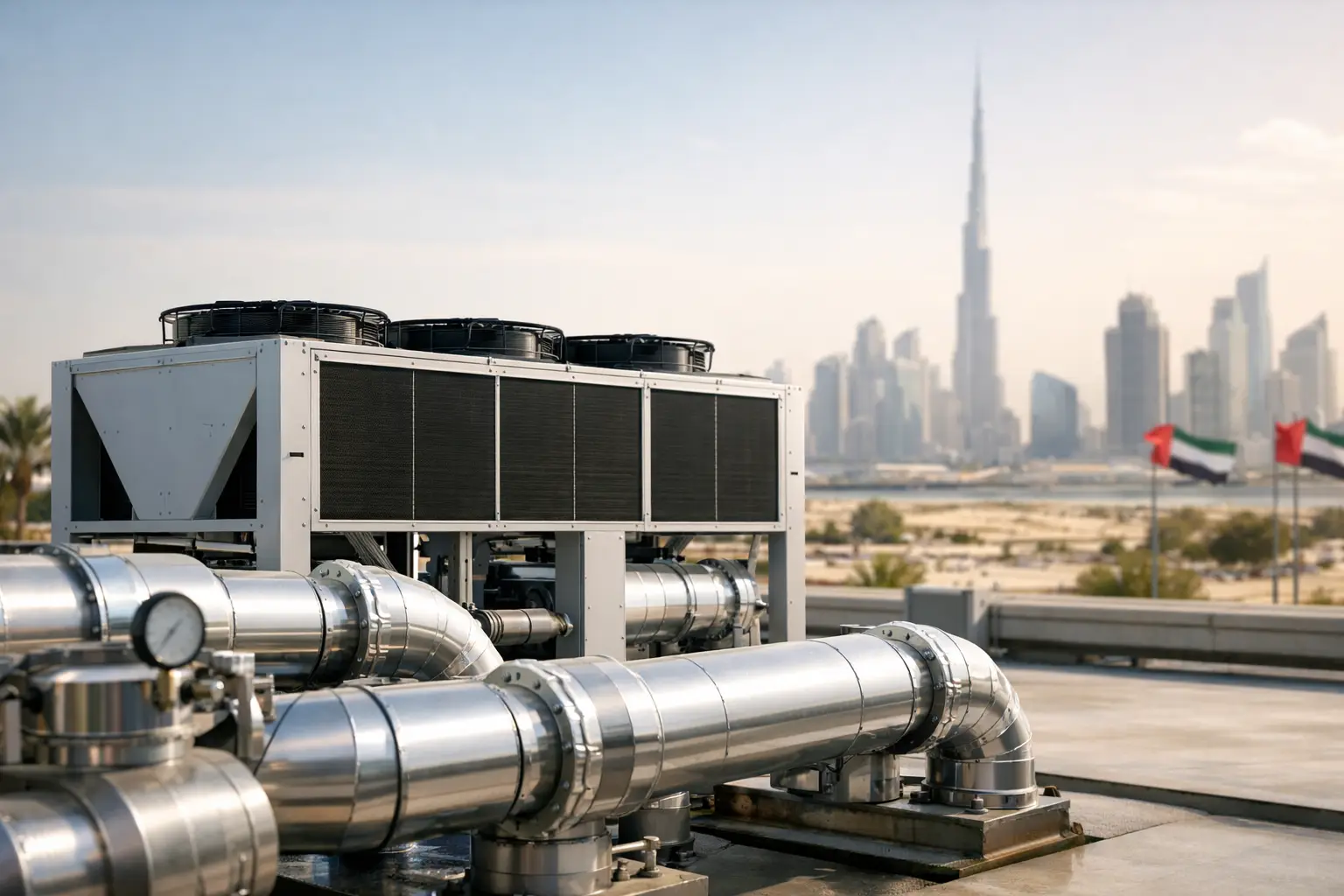
In the UAE and wider GCC region, ambient temperature has a major effect on chiller performance. A unit that looks efficient on paper may lose practical efficiency if it is undersized for high outdoor temperatures, installed in a poorly ventilated area, or forced to run continuously at full load. This is one reason engineering-based equipment selection matters more than brochure claims.
A properly designed system should maintain the required leaving water temperature without frequent short cycling or excessive compressor loading. Stable operation usually means lower energy consumption over time, especially in industrial process cooling, dialysis applications, and cold storage support systems where temperature control must remain consistent.
Why cooling load calculation comes first
Before discussing models, controls, or compressors, the first question should be simple: what is the real cooling load?
This is where many projects go wrong. Many contractors oversize systems to “be safe,” while others select chillers using rough assumptions instead of measured or calculated demand. Oversizing often leads to frequent start-stop operation, poor part-load behavior, and wasted energy. Undersizing creates a different problem – the chiller struggles to pull down temperature, runs constantly, and still fails to meet process requirements.
In industrial facilities, load calculations may include machine heat rejection, product temperature targets, production hours, makeup water temperature, pump heat, and room conditions.
Dialysis cooling applications often prioritize temperature stability and consistent flow more than simple tonnage.
Swimming pools require engineers to evaluate solar exposure, pool volume, wind conditions, usage patterns, and temperature setpoints when sizing a chiller.
For a swimming pool, solar exposure, pool volume, wind, usage pattern, and setpoint all affect sizing.
A reliable supplier should review the application in detail, not just offer a standard unit. That approach builds efficiency into the project from the start.
Energy efficient water chiller options by application
The right answer depends on what the chiller is cooling.
Industrial process cooling
In packaging, food processing, and production environments, chillers often operate for long hours under repeatable loads. Here, energy savings can be significant when the system is matched to actual process demand. Air-cooled chillers are common because they simplify installation and avoid the water treatment requirements of cooling towers. However, coil design, fan control, and compressor staging become very important in hot climates.
For these sites, a process chiller should be evaluated on temperature accuracy, recovery time, and part-load operation. A unit that performs well during startup but wastes power during steady production is not truly efficient.
Medical and dialysis cooling
Dialysis cooling is a specialized application where stable water temperature supports safe equipment operation and patient comfort. In these projects, efficiency cannot come at the expense of reliability. The system must hold temperature accurately and operate quietly and consistently.
An engineering-led approach may include redundancy planning, compact installation layouts, and controls tailored to the actual dialysis setup. The result is not just lower energy use, but fewer interruptions and better confidence in daily operation.
Commercial buildings and villas
For commercial properties and residential projects, efficiency often depends on load variation. Occupancy changes, sun exposure, and seasonal patterns affect operation. A chiller with good control flexibility can reduce unnecessary runtime and keep electrical demand more manageable.
In villas and small commercial sites, noise level, physical footprint, and maintenance access are also part of the efficiency conversation. A unit that is difficult to service may gradually lose performance if cleaning and inspection are delayed.
Design features that improve real-world efficiency
A few technical features make a measurable difference when properly applied.
High-efficiency compressors help reduce power draw, especially when selected for the intended operating range rather than just peak capacity. Microchannel or well-designed condenser coils can improve heat rejection, though their suitability depends on site cleanliness and maintenance practices. Electronic expansion valves can support tighter refrigerant control and more stable operation under changing loads.
Control strategy is equally important. Multi-stage or capacity-controlled compressors reduce waste when the load is lower than peak demand. Smart controllers can manage setpoints, alarms, pump sequencing, and anti-short-cycle protection. In practical terms, this means the chiller spends more time operating efficiently and less time reacting to poor system design.
Hydraulic design also matters. Correct pump sizing, insulated piping, buffer tank selection, and proper flow rates all affect how hard the chiller must work. A good refrigeration circuit can still perform poorly if engineers design the water side incorrectly.
A practical example from the field
A useful way to judge an energy efficient water chiller is to look at how it performs in an actual application. Consider a packaging facility in Sharjah experiencing rising power consumption and frequent production pauses due to unstable cooling water temperature. The previous contractor selected the setup years earlier without reviewing machine load, ambient conditions, or future line expansion.
After evaluating the process heat load, operating hours, and temperature requirement, the solution was not simply a bigger replacement. Engineers solved the problem by installing a correctly sized air-cooled process chiller with improved control logic, a properly matched pump arrangement, and a buffer configuration that reduced rapid cycling. Engineers designed the system to maintain process water within a narrow temperature band during both peak production and partial-load operation.
The measurable outcome was more stable machine performance, fewer temperature-related stoppages, and lower compressor stress because the chiller no longer had to chase fluctuating demand. This kind of result matters more than generic efficiency claims. It connects system design directly to production reliability.
For companies like AARMOS, every project should create this kind of documented engineering story – the site condition, the cooling problem, the selected specification, and the operating benefit after installation.
Common mistakes that reduce chiller efficiency
Factors beyond the chiller itself cause many efficiency problems. They come from decisions around it.
Poor ventilation around an air-cooled unit can raise condensing temperature and power consumption. Dirty condenser coils reduce heat rejection. Incorrect water flow affects evaporator performance. Long pipe runs without proper insulation increase thermal losses. Operators sometimes lower setpoints unnecessarily, forcing the system to work harder than the process requires.
Maintenance is another major factor. Even a well-designed machine will lose efficiency if technicians maintain an incorrect refrigerant charge, allow sensors to drift out of calibration, ignore underperforming fans, or neglect heat exchangers. That is why after-sales support should be part of the buying decision, especially for facilities where downtime is expensive.
FAQs about energy efficient water chillers
How do I know what size chiller I need?
You need a proper cooling load calculation. This should include equipment heat load, water temperatures, flow rate, ambient conditions, operating hours, and future expansion if relevant. Guesswork usually leads to inefficient operation.
Are air-cooled chillers efficient in the UAE?
Yes, when they are correctly selected for high ambient conditions and installed with adequate airflow and service clearance. In many applications, they are a practical and efficient choice because they simplify the system and reduce water-side maintenance.
Does a bigger chiller save more energy because it works less?
Not necessarily. Oversized chillers often cycle too frequently or run inefficiently at low load. Correct sizing is usually better for both efficiency and equipment life.
Is efficiency more important than reliability?
No. In real projects, the best system balances both. A slightly lower theoretical efficiency may be the better choice if it delivers stronger reliability, easier maintenance, and more stable temperature control for the application.
Can an older system be improved without full replacement?
Sometimes, yes. Controls, pumps, insulation, buffer tanks, airflow conditions, and maintenance issues can all affect performance. A technical assessment can show whether optimization is possible before replacement is considered.
Choosing the right chiller is an engineering decision, not a catalog exercise. If your facility, medical setup, commercial property, or pool system needs dependable cooling with better operating efficiency, contact AARMOS for an application-focused assessment and a solution built around your actual load, site conditions, and long-term performance goals.
Recent Comments
No comments to show.