Choosing an Industrial Process Water Chiller
A packaging line that runs hot for even one shift can waste material, slow output, and turn a small cooling issue into a production problem. That is why an industrial process water chiller should never be treated as a standard utility item. In most facilities, it is directly tied to product quality, machine stability, and uptime.
For factory owners, project managers, and MEP contractors, the real question is not simply which chiller to buy. The better question is which system will hold the required temperature under actual operating conditions, fit the process, and stay dependable over time. That is where engineering matters more than catalog specifications.
What an industrial process water chiller actually does
An industrial process water chiller removes heat from equipment, products, or production areas where temperature control affects performance. In practical terms, it circulates chilled water through a process and keeps that water within a target temperature range. The heat absorbed from the process is then rejected through the condenser.
That sounds straightforward, but applications vary widely. A plastic processing machine, a food production line, a laser system, and a packaging factory can all need chilled water, yet each one behaves differently. Some loads are steady, some spike during peak production, and some are highly sensitive to even small temperature fluctuations.
This is why a process chiller should be selected around the application, not just tonnage. Water temperature setpoint, ambient conditions, flow rate, pump head, heat exchanger type, and control logic all influence whether the system performs well in the field.
Why process cooling fails when sizing is too generic
One of the most common problems in industrial cooling is oversimplified load selection. A facility may estimate chiller capacity from machine nameplate data or copy a previous project without recalculating the actual heat load. On paper, the numbers may look acceptable. On site, the system may short cycle, struggle in summer, or fail to pull the process down to the required temperature.
In the UAE and across the GCC, ambient conditions make this even more critical. An air-cooled unit that works comfortably in mild weather may lose effective performance when outdoor temperatures rise sharply. If the system has no practical allowance for site conditions, fouling, expansion, or load variation, downtime becomes more likely exactly when production demand is highest.
A proper engineering approach starts with
cooling load calculation. That includes the heat generated by the process, operating hours, entering and leaving water temperatures, required flow, and the environmental conditions around the equipment. It also considers how the customer plans to operate the plant six months and three years from now.
Industrial process water chiller design factors that matter most
Temperature stability
Some factories only need general cooling, where a small variation is acceptable. Others need tight control because product dimensions, viscosity, curing behavior, or machine protection depend on stable water temperature. In those cases, the controls, tank design, and compressor staging become just as important as raw cooling capacity.
Air-cooled versus application demands
Air-cooled chillers are often the practical choice for industrial facilities because they are simpler to install and maintain. They work especially well where water use needs to be limited or plant infrastructure is constrained. But they still need to be chosen with realistic ambient assumptions, proper condenser airflow, and service access.
Hydraulic design
A chiller is not just a refrigeration circuit. It is also a water circulation system. If the pump is not matched to the process piping and pressure drop, the required flow may never reach the machines. That can lead to poor heat transfer, nuisance alarms, and uneven process performance.
Build quality and serviceability
In real projects, maintenance access matters. Control panels should be practical, components should be serviceable, and critical protections should be standard rather than optional. A well-built unit reduces both emergency callouts and production risk.
Application example: packaging factory cooling
A useful example is a packaging facility where continuous production created high process temperatures around converting and sealing equipment. The customer was dealing with unstable machine performance during peak shifts, especially in hotter months. The issue was not just discomfort in the production space. Product consistency and line efficiency were being affected.
The solution in this type of project starts with site review rather than immediate equipment selection. Heat load from the machines, operating cycle, water temperature requirement, and installation space must all be checked. In one typical packaging application, the recommended design included an
air-cooled process chiller with insulated water piping, a correctly sized circulation pump, and control settings matched to actual production conditions rather than generic factory defaults.
The measurable benefit in such projects is usually seen in steadier machine operation, reduced process interruption, and better product consistency. It can also lower stress on machine components that were previously operating at elevated temperatures. For plant managers, that is often the difference between reacting to recurring faults and running a more predictable operation.
Application example: food processing and temperature-sensitive production
Food processing facilities add another layer of complexity because process temperature can affect hygiene, product quality, and holding times. Cooling may be required for mixing equipment, filling lines, process water loops, or production areas tied to sensitive ingredients.
In these cases, chiller selection should account for washdown environments, duty cycle, and the consequences of temperature drift. A unit that is technically large enough may still be the wrong fit if controls are inconsistent or if the water circuit is not designed for clean, stable operation.
For customers in food production, dependable cooling usually matters more than theoretical peak efficiency numbers. The best system is the one that holds process conditions consistently and can be supported quickly if an issue arises.
Why local operating conditions change the answer
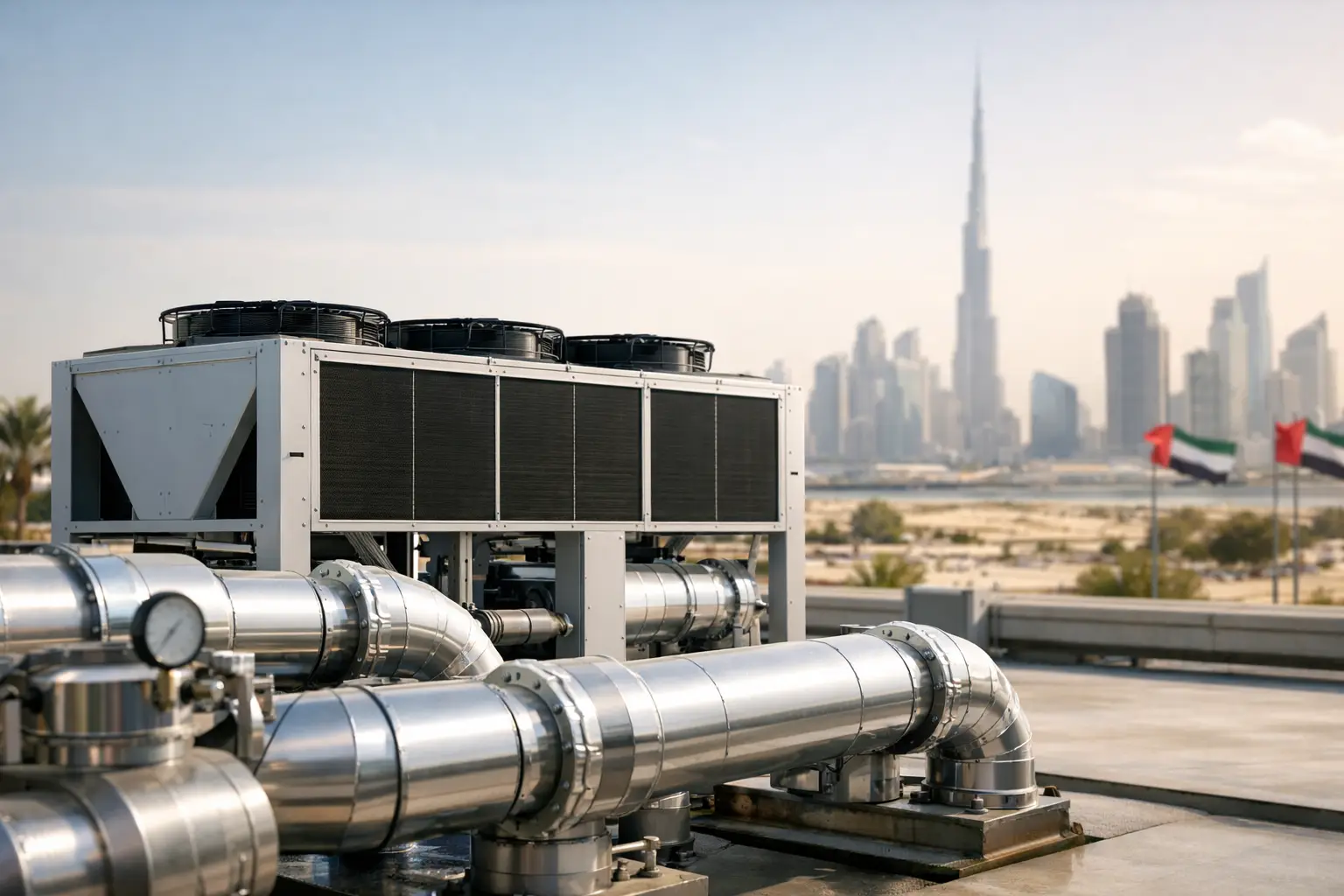
A chiller installed in Dubai, Abu Dhabi, Sharjah, or Al Ain is not being asked to perform in a neutral environment. High ambient heat, dust exposure, long operating hours, and rooftop or yard installation conditions all affect reliability. That is why location matters when it adds engineering value to the project.
For example, condenser airflow clearance may seem like a minor site detail during planning. In practice, poor clearance can reduce heat rejection, increase compressor stress, and raise the chance of summer shutdowns. The same applies to poor water quality, undersized piping, or inadequate electrical planning.
A supplier focused only on delivering equipment may stop at the unit selection. An engineering-driven cooling partner looks at the full operating context – load, piping, controls, installation layout, and service access.
Service support is part of the system
A process chiller is only as dependable as the support behind it. Industrial customers rarely need just a machine. They need load assessment, equipment selection, commissioning, troubleshooting, and after-sales response when production is at risk.
That is especially true for facilities with continuous or near-continuous operation. Preventive maintenance should include refrigerant circuit checks, electrical inspection, condenser cleaning, pump review, control verification, and water-side assessment. Small issues caught early can prevent shutdowns that cost far more than the service visit.
For that reason, every installation should become a case study in performance, not just delivery. Project photos, operating data, site conditions, and application notes all help future customers understand what was solved and why the solution worked.
FAQs
How do I know what size industrial process water chiller I need?
You need a cooling load calculation based on the actual process, not only machine labels. Key inputs include heat load, flow rate, required leaving water temperature, ambient conditions, and operating hours.
Are air-cooled chillers suitable for industrial use in the UAE?
Yes, when they are properly selected for local ambient conditions and installed with correct airflow clearance and maintenance access. Poor selection is usually the problem, not the air-cooled concept itself.
What temperature can a process chiller maintain?
That depends on the application and system design. Many industrial systems are designed for a stable chilled water range suited to the process, but the right setpoint depends on product and machine requirements.
What causes repeated chiller trips in factories?
Common causes include undersized capacity, dirty condensers, poor airflow, low water flow, control mismatch, and neglected maintenance. Repeated trips usually point to a system or site issue, not just a single faulty part.
Can one chiller serve multiple machines?
Yes, if the hydraulic design, load diversity, and control strategy are properly planned. Shared systems can work very well, but they need correct balancing and future expansion allowance.
When an industrial process cooling system is selected with real operating conditions in mind, it becomes a production asset rather than a recurring concern. If you are planning a new facility, upgrading a packaging line, or solving a temperature control issue in an existing plant,
contact AARMOS for an engineering review and a practical chiller solution built around your process.