Aarmos Commercial Building Cooling Solutions
When tenants complain about hot spots on one floor, lobby humidity near the entrance, and rising utility use at the same time, the issue is rarely just a weak unit on the roof. Commercial building cooling solutions work best when they are treated as an engineered system – one that matches occupancy, heat load, ventilation demand, building layout, and operating hours.
For commercial property owners, facility managers, MEP contractors, and project teams, that distinction matters. A building can have expensive cooling equipment and still struggle with uneven temperatures, short cycling, poor humidity control, or frequent service calls. The difference usually comes down to load calculation, equipment selection, piping and airflow design, controls, and after-sales support.
What commercial building cooling solutions need to solve
In a commercial building, cooling is not only about lowering room temperature. The system must manage sensible heat from people, lighting, glazing, and equipment while also controlling latent heat from outdoor air and internal moisture. That challenge changes significantly between an office floor, a retail showroom, a clinic, a hotel common area, and a mixed-use property.
A practical cooling design starts by asking how the building is actually used. Peak occupancy matters. Solar gain matters. Fresh air requirements matter. Server rooms, kitchens, lift lobbies, and glass-heavy facades all create different cooling behavior inside the same property. If those variables are ignored, the result is often oversized or undersized equipment, unstable indoor conditions, and wasted energy.
This is why engineering-led commercial building cooling solutions are more dependable than simple
equipment substitution. Replacing one chiller with another of similar nominal capacity may restore operation for a while, but it does not fix root causes such as poor hydraulic balance, incorrect pump sizing, fouled heat exchangers, or control sequences that force the plant to work harder than necessary.
Choosing the right system for the building
There is no single best cooling system for every commercial building. It depends on building size, usage profile, available plant space, water quality conditions, maintenance strategy, and future expansion plans.
Air-cooled chillers for practical deployment
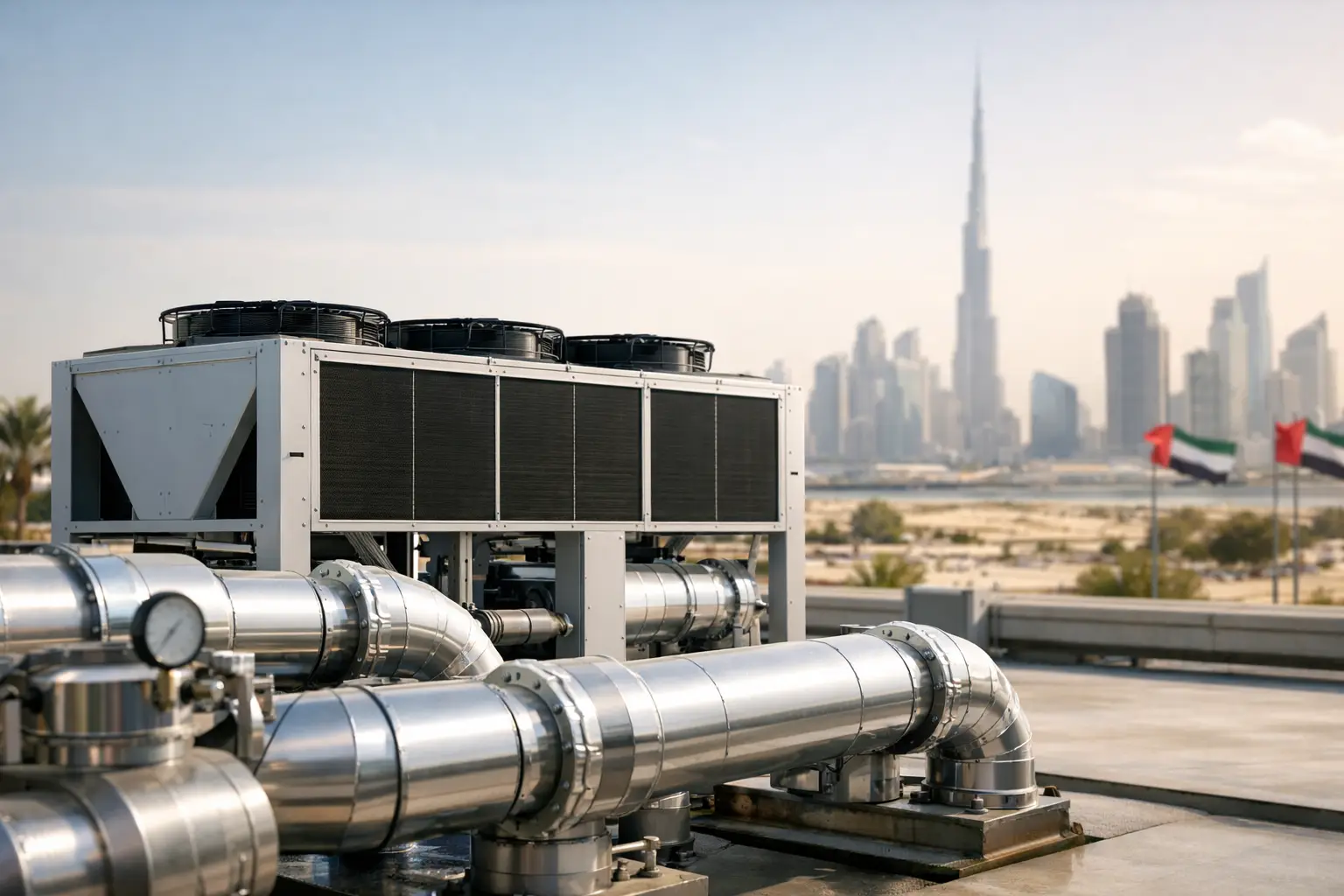
Air-cooled chillers are a common choice for commercial applications because they are relatively straightforward to install and do not require cooling towers. For office buildings, schools, clinics, and smaller mixed-use developments, they offer a practical balance between performance and installation simplicity. They are especially useful where rooftop or outdoor plant area is available and water management needs to be kept simple.
That said, air-cooled systems must be selected carefully for local ambient conditions. In hot climates, condenser performance, coil sizing, airflow clearance, and compressor staging have a direct impact on system stability. If these details are missed, efficiency drops at the exact time the building needs the most cooling.
Chilled water systems for larger or more demanding sites
For larger commercial buildings, chilled water systems often make better long-term sense. They can support multiple air handling units, fan coil units, and zones with greater control and flexibility. They are well suited for office blocks, malls, medical facilities, and institutional buildings where occupancy and cooling demand vary across the day.
The advantage is not just capacity. A properly designed chilled water system can improve comfort consistency, simplify zoning, and make future expansion easier. The trade-off is that design, installation, and controls must be handled with care. Pipe sizing, pump head, buffer requirements, and control integration all affect real-world performance.
Why cooling load calculation comes first
One of the most common reasons cooling systems underperform is that the load estimate was too basic. A rule-of-thumb approach may be fast, but commercial projects rarely behave like textbook examples.
A proper load calculation should consider floor area, glass exposure, wall and roof construction, lighting density, occupancy pattern, equipment loads, outside air intake, and operating schedule. It should also reflect local climate conditions and the building’s actual use, not just the original design intent. A retail space with digital displays and frequent door opening behaves differently from a private office with fixed occupancy.
This is where an engineering-focused provider creates value. By calculating the actual cooling requirement before
selecting a chiller or packaged system, the project team avoids two expensive mistakes: undersizing, which leads to discomfort and downtime, and oversizing, which often creates inefficient cycling, control instability, and unnecessary capital burden.
Common failure points in commercial cooling projects
Many commercial cooling problems are not caused by equipment defects alone. They come from design and execution gaps that show up only after the building is occupied.
A frequent issue is poor zoning. One thermostat or one operating schedule for very different spaces rarely works. Another is inadequate ventilation integration, where the cooling plant fights against unmanaged fresh air loads. In some projects, pipework losses were underestimated, which leaves terminal units starved of chilled water during peak demand.
Control logic is another weak point. If pumps, valves, and chillers are not sequenced properly, the system can run continuously at inefficient conditions. Even high-quality equipment will disappoint if sensors are poorly placed, balancing is incomplete, or the building management settings were never tuned after commissioning.
A project mindset that turns work into a case study
The best commercial installations are documented like case studies because that is how performance improves over time. Each project should record the original problem, design assumptions, selected equipment, installation constraints, commissioning data, and operating results.
For example, a commercial office property in Dubai may struggle with afternoon perimeter overheating due to heavy west-facing glazing. The solution may not be a larger chiller alone. It could involve recalculated loads, improved AHU coil selection, better chilled water balancing, and control adjustments tied to actual occupancy hours. The measurable result might be more stable room temperature, fewer complaints, and lower compressor cycling during peak periods.
Likewise, a retail building in Sharjah may need dependable cooling during long operating hours with high customer traffic and repeated door opening. In that case, equipment selection should account for ventilation load swings and humidity control, not just nominal tonnage. Real project photos, commissioning records, and before-and-after operating data make these outcomes credible and useful for future clients facing similar conditions.
Commercial building cooling solutions and long-term reliability
Reliability matters as much as initial performance. Building operators are not looking for a system that works well on handover day and then becomes difficult to maintain six months later. They need predictable operation, accessible service points, available spare parts, and technical support when conditions change.
That is why component quality and service planning matter. Compressors, heat exchangers, pumps, controls, and safeties should be selected as part of a serviceable system, not as isolated parts. Preventive maintenance should include refrigerant checks, condenser coil cleaning, electrical inspections, water-side treatment review, sensor calibration, and operating trend analysis.
A dependable cooling partner also plans for the building’s future. Tenancy changes, extended operating hours, fit-out modifications, and equipment additions can all shift the load profile. Systems with no design margin or no control flexibility become expensive to adapt.
Energy efficiency without sacrificing comfort
Energy efficiency is important, but it should be pursued through sound engineering rather than aggressive settings that compromise comfort. Raising chilled water temperature, changing setpoints, or reducing operating hours may save energy on paper, but if comfort complaints rise or humidity becomes uncontrolled, the building ends up paying elsewhere.
The better approach is to improve plant efficiency through proper staging, variable flow where appropriate, clean heat transfer surfaces, and controls that respond to actual demand. In many buildings, substantial gains come from correcting operating logic and hydraulic performance rather than replacing the entire system.
For commercial properties in the UAE and wider GCC, ambient conditions place additional stress on cooling equipment. This makes equipment selection, condenser performance, and maintenance discipline especially important. Systems must be built and supported for real site conditions, not ideal ones.
FAQs about commercial building cooling solutions
What is the best cooling system for a commercial building?
It depends on the building type, load profile, operating hours, and maintenance requirements. Air-cooled chillers are often practical for many commercial sites, while chilled water systems may be better for larger or more complex buildings.
Why do some buildings stay unevenly cooled even with new equipment?
New equipment does not fix poor zoning, bad balancing, control issues, duct or pipe design problems, or incorrect load assumptions. The full system needs to be reviewed.
How do you know if a chiller is correctly sized?
The correct method is a detailed cooling load calculation based on occupancy, fresh air, solar gain, internal equipment load, and actual building use. Nameplate replacement alone is not enough.
Can cooling systems be upgraded without replacing everything?
Often, yes. In some buildings, performance can improve through controls optimization, pump adjustments, coil cleaning, balancing, or partial equipment upgrades. It depends on the condition of the existing plant.
What should a commercial building owner expect from a cooling partner?
More than equipment supply. The right partner should assess the load, recommend a suitable system, support installation, verify performance, and stay available for maintenance and troubleshooting.
If your building has recurring cooling issues, rising operating strain, or a new project that needs the right system from the start,
AARMOS can help assess the load, design a suitable solution, and support installation with practical engineering focus. A well-designed cooling system should do more than run – it should keep the building comfortable, dependable, and ready for the way people actually use it.