June 21, 2026
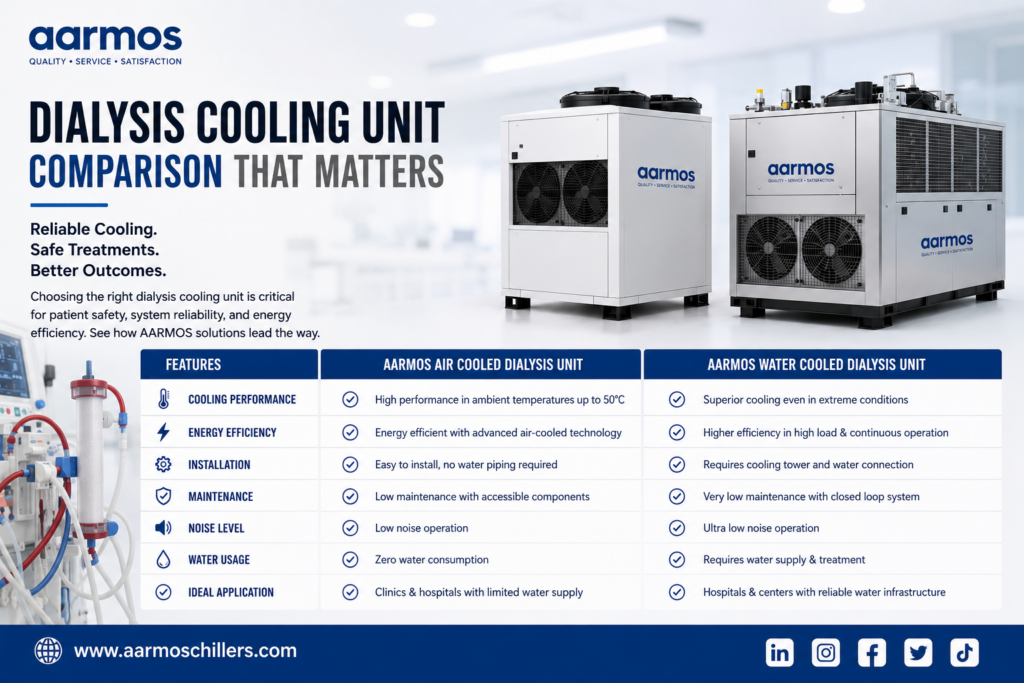
When a dialysis setup overheats, the problem is not theoretical. Treatment comfort can drop, alarms may increase, and both patients and care teams feel the effect immediately. That is why a proper dialysis cooling unit comparison should start with application reality – not brochure claims.
For healthcare providers, home dialysis users, MEP contractors, and procurement teams, the right unit is usually the one that holds stable temperature under actual operating load, fits the installation space, and can be supported quickly when service is needed. In dialysis cooling, small specification differences can create large differences in daily reliability.
What a dialysis cooling unit comparison should actually measure
Many comparisons focus too heavily on nominal tonnage or advertised cooling capacity. Those numbers matter, but they do not tell the full story. Dialysis cooling performance depends on entering water temperature, ambient conditions, circulation design, machine count, and the length of time the system must operate without drift.
A useful comparison starts with four engineering questions. First, what heat load is the unit expected to handle? Second, how tightly must it maintain water temperature? Third, is the application a single home dialysis machine, a small clinic, or a multi-station center? Fourth, what happens when ambient temperatures rise sharply, as they often do in Gulf conditions?
This is where engineering-led selection matters. A unit that performs well in a mild indoor test environment may struggle on an exposed rooftop, in a utility room with poor ventilation, or in a healthcare facility where operating hours extend longer than initially planned.
Capacity is not the same as suitability
In any dialysis cooling unit comparison, capacity should be read together with operating conditions. Two units may both be labeled for the same cooling range, yet one may lose effective performance at higher ambient temperatures while another remains stable.
For a single-machine application, oversizing can create unnecessary cycling and inefficiency. Undersizing is worse. It can lead to temperature instability, frequent compressor operation, and shorter equipment life. For multi-station dialysis environments, the comparison must account for diversity factor, simultaneous operation, pump head, and future expansion.
A practical example is a clinic planning for six stations but operating only four at the time of installation. Choosing a unit for current demand alone may look economical at first, but it can force replacement or add-on cooling later. A better approach is to calculate present and near-future load, then design the cooling loop accordingly.
Temperature stability under real load
Stable leaving water temperature is often more important than headline capacity. In dialysis applications, fluctuating cooling water temperatures can affect equipment consistency and patient comfort. This is why controllers, sensors, and hydraulic design deserve close attention.
A well-designed unit should maintain tight control without excessive compressor starts. Buffer volume, pump matching, and control logic all influence how the system behaves during treatment cycles. Units with poor control sequencing may appear adequate on paper but show temperature swings in live operation.
Air-cooled vs application-specific configurations
Most dialysis cooling projects in the UAE and GCC lean toward air-cooled systems because they simplify installation and reduce dependence on cooling towers or complex water infrastructure. That said, the right configuration depends on site constraints.
For a villa-based home dialysis setup, noise level, footprint, and ease of maintenance may be the deciding factors. For a healthcare facility, redundancy, service accessibility, and integration with building services may matter more. A compact outdoor air-cooled unit can work very well if airflow clearance is properly maintained and the system is protected from recirculation of hot air.
Indoor installations require even more care. Heat rejection, ventilation, condensate management, and service access must all be considered before final selection. In a weak comparison process, these factors are treated as installation issues after purchase. In a strong comparison, they are part of equipment selection from day one.
Key technical differences that affect performance
A serious dialysis cooling unit comparison should examine the refrigeration circuit, heat exchanger quality, pump arrangement, control panel design, and protection features. These are not secondary details. They are often the reason one unit performs steadily for years while another becomes a service burden.
Compressor type affects efficiency, noise, and part-load behavior. Heat exchanger sizing affects how hard the system needs to work during peak conditions. Pump selection affects water flow consistency and pressure at the dialysis machine. Control systems affect fault visibility and recovery time.
Protection features also matter. High-pressure safety, low-flow protection, phase protection where applicable, and temperature monitoring help prevent failures from escalating. For healthcare-related cooling, these safeguards are part of system dependability.
Serviceability is part of the comparison
Too many buyers compare only initial specification sheets. In practice, service access can be just as important as rated performance. Can filters, fans, pumps, and controls be accessed without dismantling half the unit? Are standard components used where possible? Is troubleshooting straightforward for field technicians?
In the GCC market, fast response matters because downtime carries operational and patient impact. A unit with accessible components and sensible layout reduces service time significantly. That translates into less disruption and lower lifecycle risk.
A field-based way to compare units
The most reliable comparisons come from project conditions, not just catalogs. On dialysis cooling projects, engineers should review site temperature, machine count, operating schedule, available electrical supply, pipe routing, and future expansion before recommending a model.
On one recent healthcare cooling requirement in the region, the customer needed dependable support for dialysis equipment in a space with limited outdoor utility area. The challenge was not just cooling load. It was balancing footprint, airflow clearance, and low-maintenance operation. By recalculating the actual load and revising the unit layout around service access, the final system achieved more stable operation and simplified maintenance planning.
That kind of result is rarely achieved through generic equipment trading. It comes from application review, cooling load calculation, and matching the unit to the site.
Home dialysis vs clinic dialysis cooling needs
Home users and clinics should not compare units the same way. For home dialysis, lower noise, compact size, electrical compatibility, and simple operation usually move to the top of the list. The user often wants a dependable cooling solution that works quietly in a residential setting and does not require constant attention.
Clinics and healthcare providers tend to prioritize continuous performance, ease of maintenance, and capacity planning. If several machines operate daily, the cost of interruption is higher. In that setting, the best unit may not be the smallest or simplest. It may be the one with stronger controls, better service access, and room for operational growth.
This is why a one-size-fits-all recommendation is rarely correct. The better path is to compare units against the actual use case.
FAQs about dialysis cooling unit comparison
What is the most important factor in selecting a dialysis cooling unit?
The most important factor is application fit. Cooling capacity must match the real heat load, but temperature stability, ambient conditions, hydraulic design, and serviceability are equally important.
Can a standard water chiller be used for dialysis cooling?
Sometimes, but not automatically. A standard chiller may work if it is properly sized and configured for the dialysis application. However, control accuracy, flow requirements, footprint, and healthcare operating conditions must be checked carefully.
Is a larger unit always better for dialysis cooling?
No. Oversized units can short cycle, waste energy, and reduce control stability. Proper load calculation gives a better result than selecting the largest available capacity.
What should clinics ask suppliers before buying?
They should ask for cooling load calculations, expected temperature range, pump and flow details, electrical requirements, service access considerations, and support availability after installation.
Why does ambient temperature matter so much in the UAE and GCC?
High ambient temperatures reduce the effective heat rejection capacity of air-cooled equipment. A unit that looks adequate in mild conditions may become unstable during hotter periods if it was not selected with local climate in mind.
A strong dialysis cooling decision comes from comparing performance where it counts – under load, in the actual environment, with realistic service expectations. If you are planning a home dialysis setup, upgrading a clinic, or specifying a dialysis water chiller in the UAE or GCC, contact AARMOS for an engineering review based on your site conditions, machine count, and required operating stability. The right cooling unit should not just meet a specification. It should make daily operation easier and more dependable.
Recent Comments
No comments to show.