May 29, 2026
Dialysis Machine Cooling System Basics
A dialysis machine cooling system is not an accessory. In many installations, it is the difference between stable treatment conditions and recurring temperature-related faults that disrupt care, shorten equipment life, and create avoidable stress for staff and patients.
In the UAE and across the GCC, that reality becomes more serious. High ambient temperatures, warm utility spaces, and continuous equipment operation can push dialysis support systems beyond comfortable limits. For clinics, hospitals, and home dialysis setups, the cooling solution has to be engineered around the actual load, the operating environment, and the level of reliability the application demands.
Why a dialysis machine cooling system matters
Dialysis depends on control. Flow rates, pressure, water quality, and temperature all affect treatment performance. When temperature drifts outside the required range, the machine may alarm, operate inefficiently, or require intervention that interrupts routine care.
A properly designed dialysis machine cooling system helps maintain stable operating temperatures for associated water treatment and support equipment. That stability protects sensitive components, reduces nuisance shutdowns, and supports consistent daily operation. In busy treatment centers, even a small reduction in faults can make a measurable difference in staff workload and patient scheduling.
The exact cooling requirement depends on the system configuration. Some facilities need cooling for reverse osmosis water lines or storage loops, while others need a dedicated chiller integrated into a broader dialysis water infrastructure. Home dialysis applications are different again. They usually require compact equipment, lower noise, easier installation, and practical service access. The right answer is rarely off-the-shelf without some level of evaluation.
How the dialysis machine cooling system works
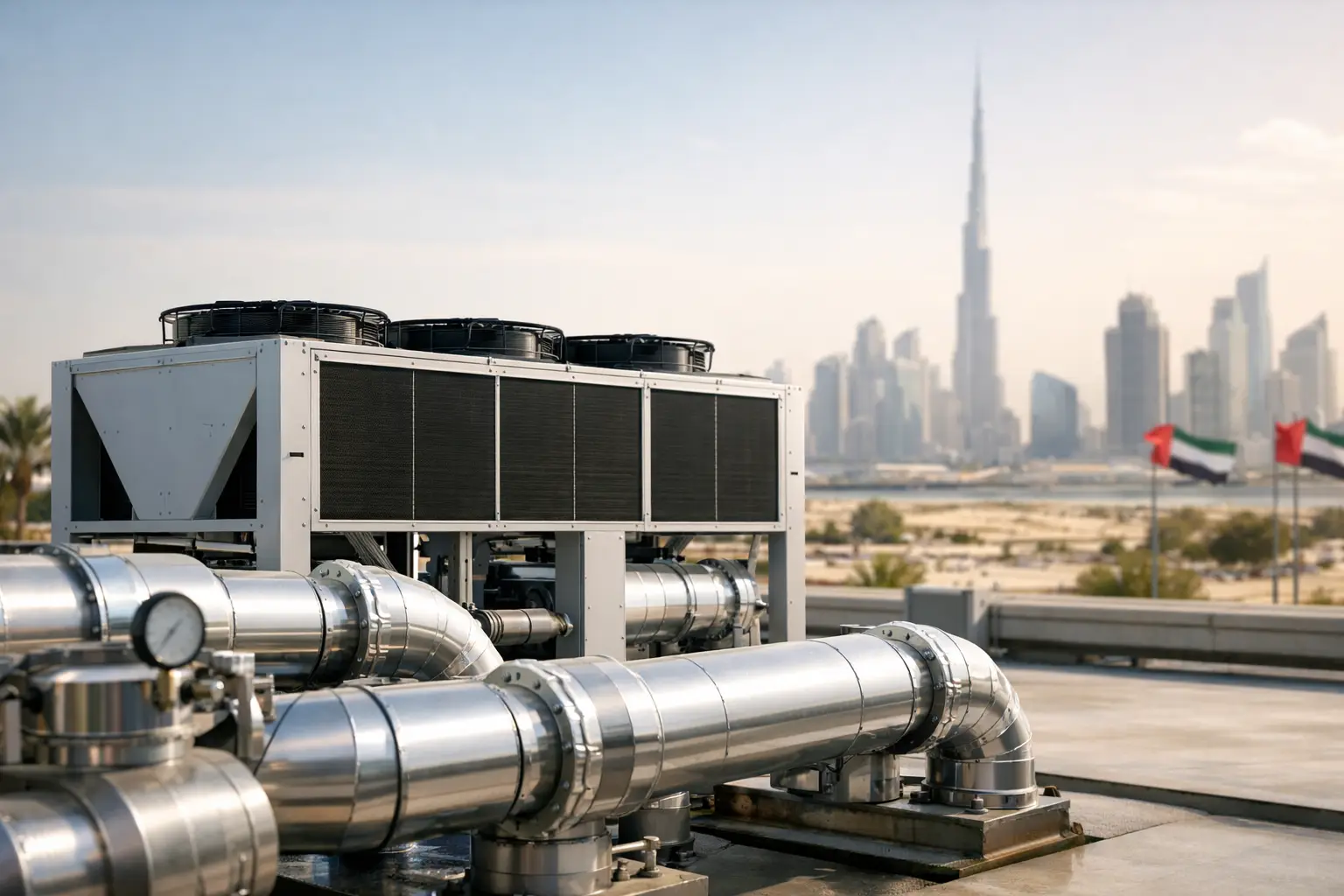
Most dialysis cooling applications use a chiller to remove heat from water or a process loop and reject that heat through an air-cooled or water-cooled system. In healthcare settings across the UAE, air-cooled chillers are often preferred because they simplify installation and avoid dependence on a separate cooling tower system.
The basic principle is straightforward. Heat generated within the process is absorbed into circulating water, moved to the chiller, and rejected to the surrounding environment. What matters in practice is not the principle but the control. The system must hold the target temperature reliably, respond to load changes, and continue operating in harsh ambient conditions.
For dialysis-related applications, engineers typically look at the required leaving water temperature, flow rate, heat load, installation space, noise considerations, water quality, and redundancy expectations. If any of those are missed during selection, the system may technically run but still underperform in real service.
Key engineering factors in system selection
Cooling load calculation comes first. Guesswork causes problems. An undersized unit may struggle through summer conditions, while an oversized unit may short cycle, waste energy, and reduce component life.
Ambient temperature is especially important in the Gulf. Equipment that performs well in a mild climate may lose capacity when exposed to rooftop or outdoor conditions in peak summer. That is why a dialysis machine cooling system for Dubai, Abu Dhabi, or Sharjah should be selected based on local design temperatures, not generic catalog assumptions.
Material selection also matters. Corrosion resistance, pump quality, control reliability, and heat exchanger suitability all influence long-term performance. For medical and institutional environments, serviceability is another practical issue. If maintenance requires long shutdown windows or difficult access, the operating team inherits that burden for years.
A practical project example
One recent requirement in the UAE involved a dialysis-related cooling application where the customer was facing rising equipment temperature during peak daytime operation. The site had limited plant space, high outdoor ambient conditions, and a clear need to avoid disruption to ongoing healthcare activity.
The solution was not simply to deliver a chiller and leave. The starting point was evaluating the actual operating load, installation constraints, and available electrical service. From there, the system was selected with a capacity margin appropriate for local summer conditions, along with controls designed for stable temperature management rather than broad fluctuation.
The installed package included an air-cooled chiller configuration suited to the site environment, practical pipe routing, and commissioning support to confirm target performance. The measurable outcome was improved temperature stability and fewer operator concerns during high-demand periods. Just as important, the customer gained a system that could be supported locally instead of a generic imported unit with uncertain after-sales response.
That is the difference between product supply and engineering-led delivery. Every project should become a reference point. Real photos, actual site conditions, operating data, and post-installation results tell a more useful story than brochure language ever will.
Common problems when cooling is poorly matched
When a dialysis machine cooling system is not designed around the application, the symptoms are usually familiar. The equipment may trip more often in hot weather, temperature recovery may be slow, and the facility team may see inconsistent performance across different operating hours.
Sometimes the issue is capacity. Sometimes it is flow. In other cases, poor ventilation around the chiller, fouled coils, incorrect piping practice, or unstable power supply contributes to the problem. That is why diagnosis should be technical and site-specific. Replacing one component without identifying the actual cause often wastes time and money.
A second common issue is assuming that healthcare cooling behaves like general commercial cooling. It does not. In comfort cooling, some temperature drift may be tolerable. In medical support applications, tighter control and more predictable performance usually matter more than simple tonnage.
What buyers should ask before choosing a system
Procurement teams and facility managers should ask how the cooling load was calculated, what ambient design conditions were used, what temperature range the system will maintain, and what service support is available locally. They should also ask whether spare parts, controls, and commissioning expertise are available in the UAE or GCC.
Energy efficiency matters, but it should be evaluated honestly. The most efficient machine on paper is not always the best option if it is difficult to service, poorly suited to the site, or unable to maintain capacity under local summer conditions. Reliability, maintainability, and stable control usually carry more weight in dialysis applications.
This is also where an engineering-focused supplier adds value. Instead of quoting a standard box, the right partner reviews the use case, confirms design assumptions, and recommends equipment that can perform under actual conditions.
Maintenance and long-term performance
Even a well-designed dialysis machine cooling system needs preventive maintenance. Condenser coils must stay clean, refrigerant charge must be correct, pumps and controls must be inspected, and water-side conditions should be monitored. Small deviations in these areas can lead to capacity loss long before a full failure occurs.
For healthcare operators, preventive maintenance is usually more cost-effective than reactive service. Scheduled checks reduce the chance of emergency callouts, help preserve equipment life, and make system behavior more predictable during critical periods.
Facilities with continuous or near-continuous operation may also benefit from planning redundancy or standby capacity. Whether that is necessary depends on patient load, treatment schedule, and the risk tolerance of the site. Not every installation needs a backup arrangement, but many should at least evaluate it.
FAQs about dialysis machine cooling system design
What temperature should a dialysis cooling system maintain?
There is no single answer for every site. The required temperature depends on the dialysis support equipment, water treatment design, and manufacturer requirements. The correct setpoint should come from system design data, not assumption.
Is an air-cooled chiller suitable for dialysis applications in the UAE?
Often, yes. Air-cooled chillers are commonly used because they are simpler to install and maintain. The key is selecting a unit rated for high ambient conditions and matching it correctly to the load.
Can home dialysis setups use a dedicated cooling system?
Yes, in some cases a compact dedicated solution is appropriate. Home applications need careful attention to noise, footprint, electrical supply, and service access.
How do you know if the system is undersized?
Frequent high-temperature alarms, poor performance in summer, long recovery time, and unstable operation during peak demand are common warning signs. A proper load review is the only reliable way to confirm it.
How often should maintenance be carried out?
That depends on run hours, installation conditions, and equipment type. In dusty or high-heat environments, inspection intervals may need to be shorter than standard practice.
Healthcare facilities do not need guesswork when treatment support systems are involved. They need cooling that is calculated, built, installed, and supported with the same seriousness the application demands. AARMOS approaches dialysis cooling that way – by assessing the actual site, defining the load, and delivering a dependable system backed by practical service. If you are planning a new installation or dealing with recurring temperature issues in an existing setup, the next step is simple: discuss the operating conditions, share the site details, and get a solution designed for the way your facility really runs.
Recent Comments
No comments to show.