June 20, 2026
Heat pump vs pool chiller
A pool in Dubai can reach uncomfortable temperatures faster than many owners expect. By midsummer, the water may feel more like a warm bath than a place to swim. That is usually when the real question comes up: should you install a heat pump or pool chiller, and which option will actually solve the problem for your property, usage pattern, and climate?
For villas, hotels, compounds, and commercial facilities across the UAE and GCC, the answer is not the same in every case. The right choice depends on whether you need cooling, heating, or both, how large the pool is, how often it is used, and how stable you need the water temperature to remain during peak outdoor conditions. This is where engineering matters more than product labels.
Heat pump or pool chiller: the core difference
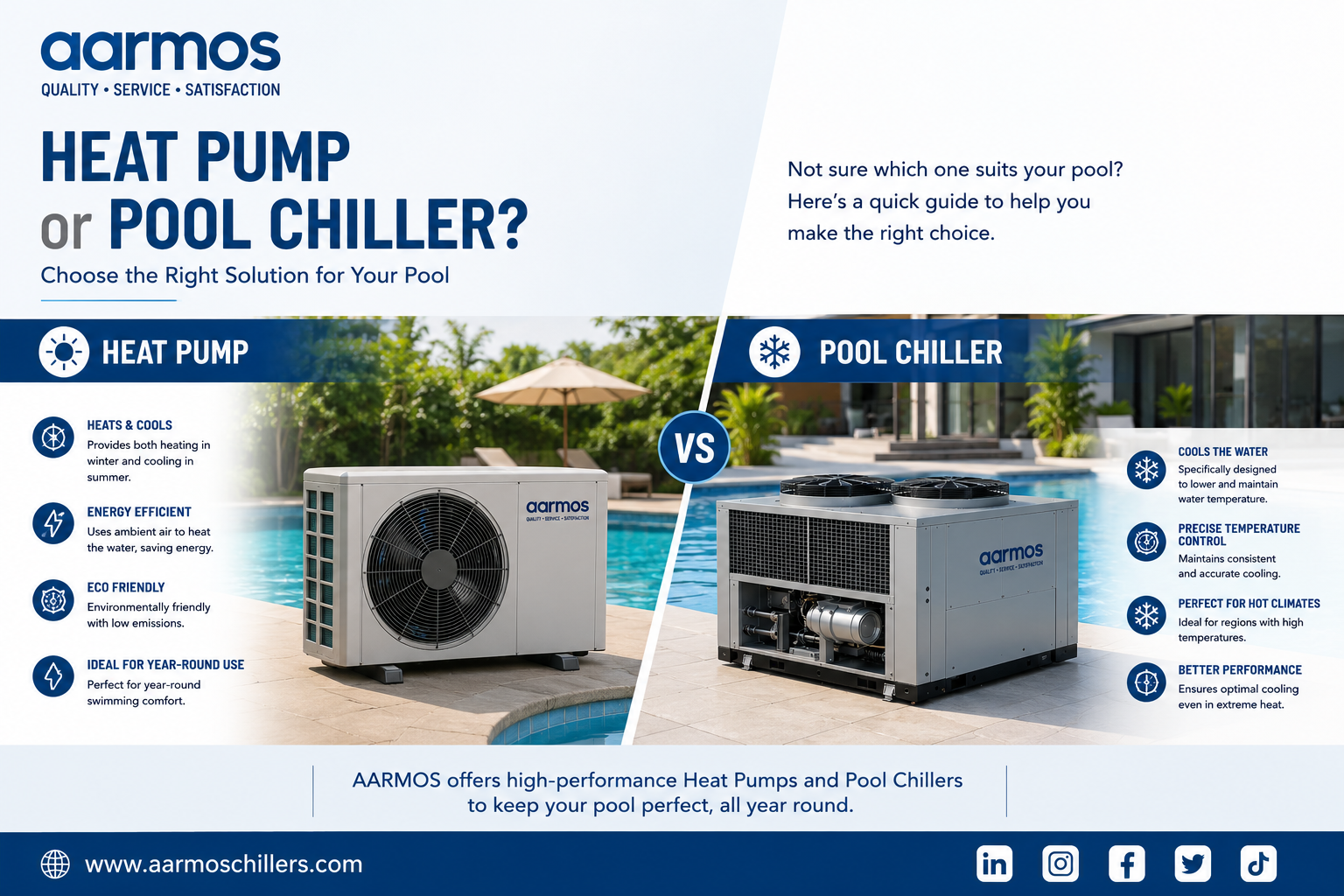
Manufacturers design pool heat pump primarily to raise water temperature. It transfers heat from ambient air into the pool water, making it useful during cooler months or for pools that need extended seasonal use. Some manufacturers include reverse-cycle operation, allowing the unit to cool as well as heat, although cooling performance varies with design and weather conditions.
Manufacturers build pool chillers specifically to reduce water temperature. Its job is straightforward: remove excess heat from the pool and keep water within a targeted comfort range. In hot regions where ambient temperatures stay high for long periods, a dedicated chiller often provides more dependable cooling performance than a dual-purpose heat pump.
That distinction sounds simple, but it affects equipment sizing, energy use, operating hours, and the final user experience.
When a heat pump makes sense
A heat pump is usually the better fit when the main problem is cool water rather than hot water. Residential pools that are used heavily in winter, hospitality pools that require mild heating for guest comfort, and properties looking for one system that can extend the swimming season often benefit from a heat pump.
In moderate weather, a quality heat pump can operate efficiently because it is moving heat rather than generating it directly. That can make it attractive for owners focused on running cost over time. However, there is an important trade-off. As outdoor air temperature rises or falls beyond ideal ranges, the unit’s real-world performance changes. In very hot climates, reverse-cycle cooling may not deliver the same level of control as a purpose-built chiller.
For example, a villa pool that only needs occasional temperature adjustment in shoulder months may do well with a heat pump. A pool that must stay consistently cool in peak summer usually needs a more focused cooling solution.
The practical advantage of dual-purpose systems
Some owners prefer a reversible heat pump because it offers one piece of equipment for both heating and cooling. That can simplify plant area layout and reduce equipment count. For private pools with moderate demand, this approach can be reasonable.
Still, dual-purpose does not always mean best-purpose. If cooling is the primary requirement for most of the year, choosing a unit optimized mainly for heating can create disappointing results.
When a pool chiller is the better choice
A pool chiller is the stronger option when overheating is the actual problem. This is common in exposed outdoor pools, rooftop pools, hotel pools, and villa pools with high sun load. In these cases, water can absorb heat all day from solar radiation, warm deck areas, and high ambient air temperatures.
A dedicated chiller gives you tighter control over the maximum water temperature. That matters for comfort, but also for usability. If water is too warm, swimmers stay in for less time, guest satisfaction drops, and the pool may become underused during the very season it should be most attractive.
From an engineering standpoint, chillers are also easier to match to clear cooling loads. Once factors such as pool volume, surface area, exposure, circulation rate, and target temperature are calculated, the system can be selected with more confidence. That reduces the risk of undersizing, which is one of the most common reasons pool temperature systems fail to meet expectations.
Climate matters more than many buyers realize
In the UAE and wider Gulf region, summer design conditions are harsh. High dry-bulb temperatures, intense solar gain, and long daytime heat exposure can push pool water temperatures well beyond comfort range. Under these conditions, the question of heat pump or pool chiller becomes less about features and more about application suitability.
If your pool spends most of the year needing cooling, a dedicated pool chiller is often the practical answer. If your pool needs warmth in winter and only modest cooling in transitional periods, a reversible heat pump may be enough. But if your facility has year-round occupancy standards, such as a hotel, wellness center, or premium residential development, a more engineered approach may be required, sometimes even combining systems depending on the operational brief.
The sizing mistake that causes most problems
Temperature control equipment is often chosen based on pool size alone. That is not enough. Two pools with the same water volume can have very different thermal behavior.
An accurate selection should consider pool dimensions, water volume, desired temperature range, local climate data, direct sunlight exposure, bather load, water features, operating schedule, and filtration flow rate. Nearby wind exposure can also influence heat gain and heat loss. A shaded indoor therapy pool and an exposed outdoor villa pool are completely different design cases.
This is why engineering-led suppliers start with cooling load calculation, not just a brochure comparison. In practice, correct sizing leads to shorter pull-down times, steadier temperature control, lower stress on components, and better long-term reliability.
A practical field example
On one outdoor residential project in the UAE, the owner’s complaint was simple: the pool looked excellent but was barely usable during the hottest months. The water temperature climbed too high by late afternoon, especially after consecutive high-heat days. The site had full sun exposure, limited natural shading, and a moderate-volume overflow pool connected to a standard filtration system.
The solution was not to install a general-purpose unit and hope for the best. The system needed calculated cooling capacity based on actual site conditions, circulation compatibility, and target comfort temperature. Once the cooling load was established, a properly selected pool chiller was integrated into the hydraulic loop. The result was more stable water temperature, better daytime usability, and reduced complaints during peak season.
This kind of project is a good reminder that the best equipment choice usually comes from understanding the problem in engineering terms, not retail terms.
Energy use and operating expectations
Owners often ask which system is more energy efficient. The honest answer is that efficiency depends on what you are asking the equipment to do.
A heat pump can be very efficient when heating under suitable ambient conditions. A chiller can be the more efficient and effective answer when the real load is sustained cooling in extreme heat. Equipment that is poorly matched to the load may run longer, struggle to reach setpoint, and consume more power overall, even if its brochure figures look attractive.
That is why operating profile matters. A private pool used on weekends has one pattern. A hospitality pool used every day with strict comfort expectations has another. Runtime, temperature swing tolerance, and control strategy all affect the right choice.
Maintenance and long-term reliability
Both heat pumps and pool chillers need routine maintenance if you want consistent performance. Coil cleanliness, water flow, refrigerant condition, electrical health, and control calibration all affect output. In coastal and dusty environments, maintenance becomes even more important.
For commercial and institutional users, service support should be part of the buying decision. Equipment reliability is not only about manufacturing quality. It is also about installation quality, commissioning, and after-sales response. A well-selected system with poor installation can underperform just as easily as the wrong machine.
FAQ
Is a pool chiller better than a heat pump in the UAE?
If your main requirement is cooling during long, hot summers, a pool chiller is often the better fit. If you mainly need heating in cooler months, a heat pump may be more suitable.
Can a heat pump cool a swimming pool?
Some reversible heat pumps can cool, but their cooling performance may not match a dedicated chiller in high ambient conditions. It depends on the unit design and the actual site load.
What is the ideal pool temperature for comfort?
For many recreational pools, a comfortable range is often around 26 to 29 degrees Celsius. The preferred setting varies by user type, activity level, and climate.
How do you choose the right capacity?
Capacity should be based on a proper thermal load calculation, not only pool volume. Sun exposure, location, operating hours, and target temperature all matter.
Can one system handle both heating and cooling?
Yes, some reversible heat pumps can do both. They are useful in certain residential applications, but they are not always the best answer where strong cooling performance is the priority.
Choosing between a heat pump and pool chiller is really about choosing how your pool should perform, not just what machine sits in the plant area. If you want a system selected around actual load, operating conditions, and long-term dependability, AARMOS can help assess the application and recommend the right temperature control solution for your pool. The best outcomes usually start with one straightforward step: define the problem clearly, then engineer the answer properly.
Recent Comments
No comments to show.