Packaging Factory Cooling Solutions That Work
A packaging line rarely fails all at once. More often, it starts with small warning signs – film stretching inconsistently, sealing temperatures drifting, compressed air running hotter, operators complaining about floor heat, or a chiller struggling by mid-afternoon. That is where packaging factory cooling solutions move from being a utility decision to a production decision.
In packaging plants, temperature control affects more than comfort. It directly influences seal integrity, print quality, machine reliability, adhesive behavior, and output stability. For factories handling flexible packaging, labels, corrugated products, bottles, containers, or food-grade packs, cooling has to be engineered around the process, not added later as a general facility service.
Why packaging factories have different cooling demands
A packaging facility creates heat from several sources at the same time. There is the obvious process heat from sealing jaws, motors, compressors, hydraulic units, and extruders. Then there is ambient heat from lighting, roof gain, worker density, and loading bays opening repeatedly in Gulf conditions. In some plants, the product itself also carries heat into the room or must be held within a narrow temperature range before packing.
That mix matters because a comfort cooling system alone usually cannot solve it. If the process load is ignored, the result is predictable: unstable machine performance, higher stoppage rates, and equipment working harder than it should. A proper engineering approach starts by separating the loads. Process cooling, space cooling, and ventilation may overlap, but they should not be treated as the same problem.
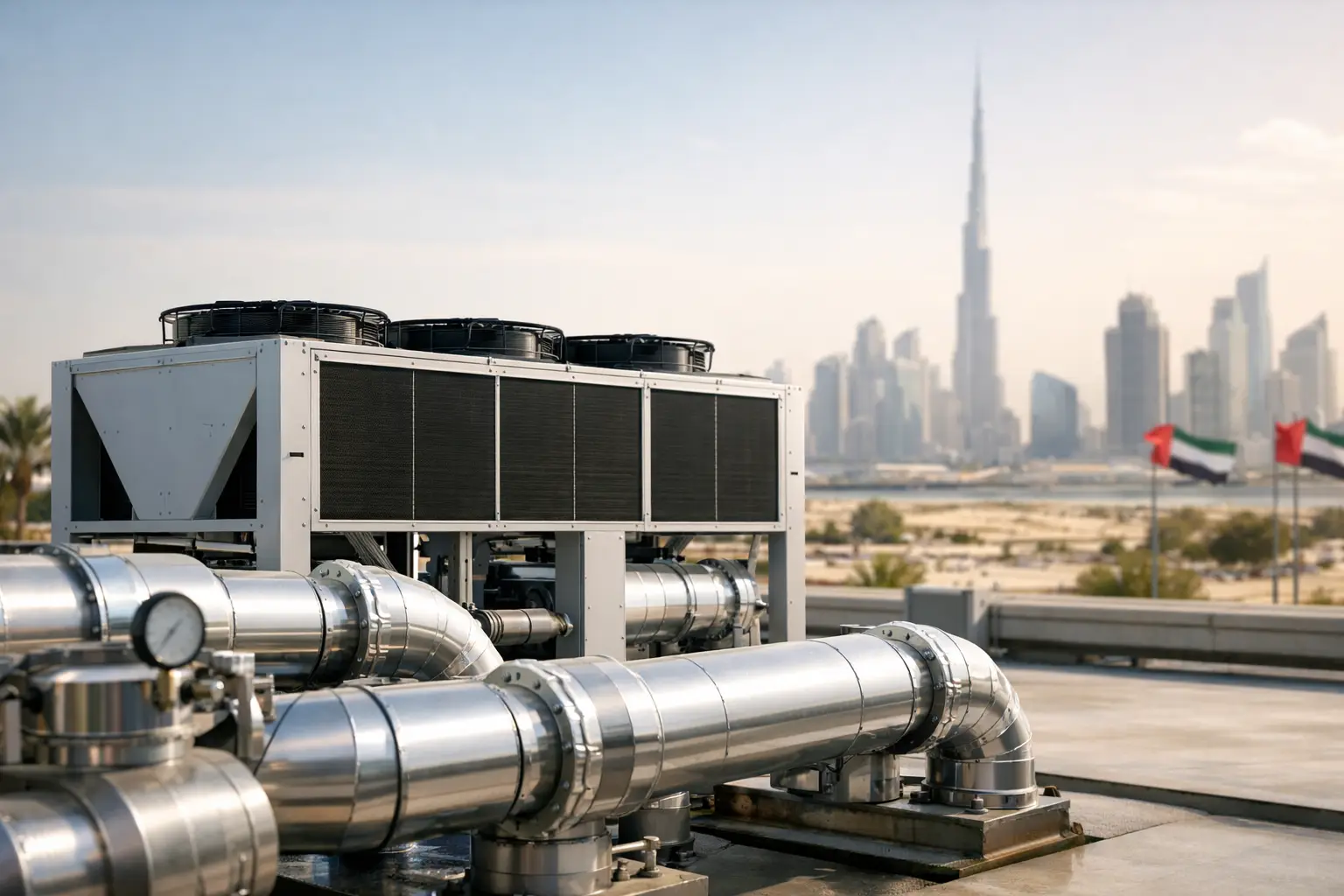
This is especially true in the UAE and wider GCC, where high outdoor temperatures increase condensing pressure and push poorly sized systems beyond their useful operating window. A cooling solution that looks adequate on paper can still underperform in real summer operating conditions.
Packaging factory cooling solutions by application
The right system depends on what the factory is making and how the line operates. There is no single chiller size or room cooling setup that fits every plant.
Process cooling for packaging machinery
Many packaging machines need stable cooling water to control heat at seals, molds, rollers, or forming stations. In flexible packaging, temperature variation can distort film behavior and affect sealing consistency. In rigid packaging and thermoforming, poor cooling can increase cycle time and create dimensional variation.
For these applications,
air-cooled water chillers are often a practical option, especially where water availability, maintenance preference, or site conditions favor a closed-loop system. The key is not just tonnage. Flow rate, entering and leaving water temperature, pump head, buffer tank sizing, and control logic all affect performance.
A common mistake is selecting a chiller based only on nominal capacity. In practice, the system has to match the actual machine load, operating hours, ambient conditions, and future production plans. Slight undersizing may save space initially, but it often leads to short cycling, unstable control, and rising maintenance calls.
Production hall cooling and ventilation
Even where machines have dedicated process cooling, the factory floor itself can become too hot for stable operations. High room temperature affects workers, electronics, material handling, and stored packaging components. Certain films, labels, inks, and adhesives become harder to control when the surrounding area is too warm or humid.
In these cases, production hall cooling may involve ducted air systems, evaporative support in selected spaces, spot cooling for hot zones, or dedicated packaged units for enclosed process rooms. It depends on the layout. A plant with open lines and frequent loading bay traffic has different needs than a sealed print room or a temperature-sensitive labeling section.
Cooling for compressed air and utility rooms
Packaging factories often overlook utility heat. Air compressors, electrical rooms, hydraulic power packs, and control panels can all add heat that spreads into production areas. If these rooms are not ventilated or cooled correctly, the heat load returns to the main floor and equipment life can suffer.
This is one of the simplest improvements in many plants. Isolating utility heat and cooling it properly can reduce the load on the main system and improve process stability without changing the production line itself.
What good system design looks like
Effective packaging factory cooling solutions start with load calculation, not catalog selection. An engineering team should review machine heat rejection, room dimensions, insulation quality, fresh air requirements, operating schedules, and peak summer conditions. If the factory runs multiple shifts or plans expansion, that should be built into the design from the start.
Pipe routing, pump selection, control panels, filtration, and redundancy also matter. In a packaging plant, unplanned downtime usually costs more than the cooling equipment itself. That is why dependable system design often includes features such as standby pump arrangements, accessible service points, and controls that help operators identify faults early.
Energy efficiency should be addressed realistically. A
more efficient chiller can reduce running costs, but only if the rest of the system supports it. Poor water flow, fouled heat exchangers, bad ventilation around condensers, or oversized pumps can waste the gains. In other words, efficiency is a system outcome, not just a product feature.
A practical project approach
In one typical packaging application in the UAE, a factory reported repeated quality variation during peak daytime hours. Operators had adjusted machine settings several times, but the issue kept returning. The root cause was not the packaging machine alone. The line was sharing cooling capacity with other loads, and the existing system had no real allowance for summer ambient rise or production increase.
After reviewing the process load, utility demand, water temperatures, and line operating pattern, the solution was redesigned around dedicated process cooling with correct buffer volume and improved circulation control. Utility heat was separated from the main production area, and the cooling capacity was matched to actual operating conditions rather than nameplate assumptions.
The outcome in this kind of scenario is usually measurable in three areas: more
stable production temperatures, fewer line interruptions, and better consistency in finished pack quality. That is the value of treating each project like a case study. The technical details matter because the customer problem is rarely generic.
When project photos, site readings, and operating data are recorded properly, they also help future maintenance and expansion. A factory manager can compare seasonal performance, identify load changes, and decide whether the next production line can be integrated into the same plant or needs separate cooling support.
Common mistakes factories make
Some cooling problems come from equipment age, but many start earlier in the decision process. The first mistake is using general building air conditioning to solve process heat. The second is assuming every packaging line has the same load profile. The third is focusing only on equipment supply without considering installation conditions, controls, and service access.
There is also a trade-off between lowest first cost and long-term reliability. A basic system may appear sufficient for normal operation, but packaging plants do not operate in laboratory conditions. Dust, shifting production schedules, outdoor heat, and utility fluctuations all stress the system. Designing for real operating conditions usually gives better value over time.
FAQ: Packaging factory cooling solutions
What type of chiller is best for a packaging factory?
It depends on the process. Many packaging plants use air-cooled water chillers because they are practical, compact, and suitable for industrial process cooling in GCC conditions. The best option depends on load, water temperature requirement, ambient conditions, and site layout.
Can one cooling system handle both machinery and factory space?
Sometimes, but not always. Combining both loads can work in smaller facilities if it is engineered correctly. In larger or more temperature-sensitive plants, separating process cooling from space cooling usually gives better control and easier troubleshooting.
Why does cooling performance drop in summer?
Higher outdoor temperatures increase the stress on condensers and reduce system efficiency if the unit is not sized or installed properly. Poor airflow, dirty coils, and underestimated heat load make the problem worse.
How do you calculate cooling load for packaging machinery?
The calculation should consider machine heat rejection, cycle times, operating temperatures, water flow requirements, room conditions, and concurrent loads. That is why site review and technical data collection are essential before selecting equipment.
Is preventive maintenance really necessary if the system is running fine?
Yes. In packaging operations, many failures build gradually. Preventive maintenance helps catch issues such as low flow, refrigerant problems, fouling, or electrical stress before they affect production.
A reliable cooling system should support output, protect product quality, and make plant operations easier to manage in real conditions. If your packaging facility is dealing with unstable temperatures, recurring stoppages, or an undersized chiller, AARMOS can assess the load, review the application, and recommend a practical engineered solution built for long-term performance.