June 25, 2026
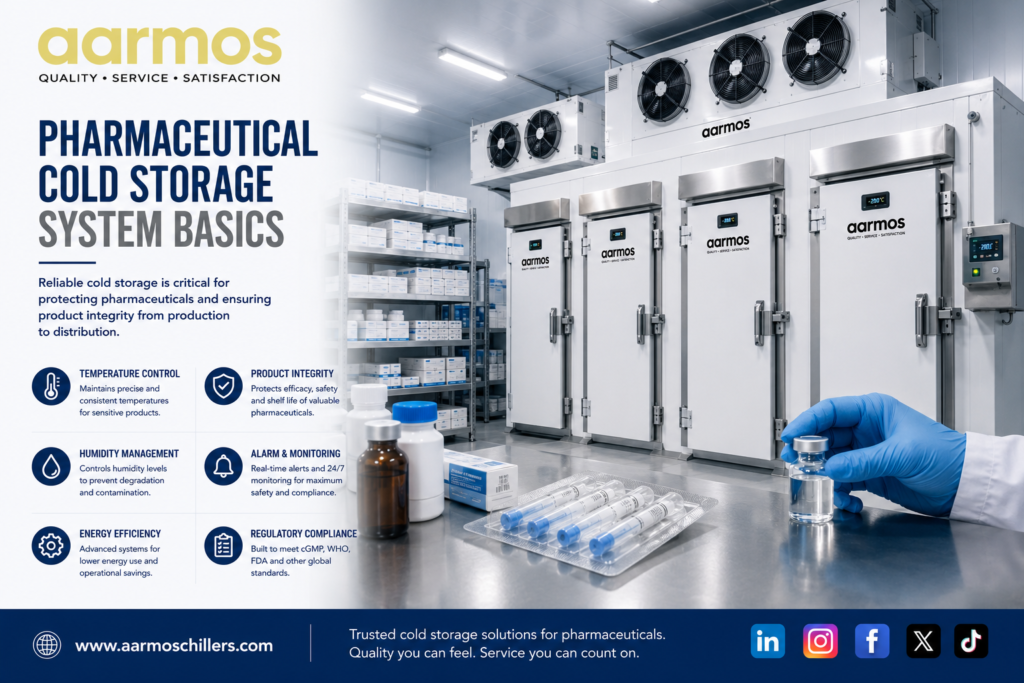
A vaccine batch can lose value long before anyone sees visible damage. A few degrees above range during receiving, storage, or transfer may be enough to compromise product quality, create compliance risk, and force costly disposal. That is why a pharmaceutical cold storage system is not just a refrigerated room. It is a controlled environment designed around product stability, operating discipline, and failure prevention.
For healthcare providers, distributors, laboratories, and medical storage operators, the real question is not whether cold storage is needed. The real question is what level of control, monitoring, redundancy, and service support is required for the products being stored. In pharmaceutical applications, small design shortcuts often create large operational problems later.
What makes a pharmaceutical cold storage system different
Standard cold rooms are built to keep a space cold. A pharmaceutical cold storage system must do more than that. It must maintain a validated temperature band, recover quickly after door openings, minimize hot and cold spots, and provide traceable records. In many facilities, it also needs alarm handling, backup planning, and integration with site operations.
This difference matters because medicines, vaccines, reagents, biologics, and other temperature-sensitive materials do not all respond the same way to storage conditions. Some products tolerate brief fluctuations better than others. Some require 2°C to 8°C stability, while others may need frozen storage or tightly controlled low-temperature environments. The storage envelope should be selected based on the product profile, not copied from a general cold room specification.
From an engineering standpoint, pharmaceutical storage puts more attention on air distribution, sensor placement, insulation quality, door management, refrigeration sizing, and controls. If any one of these elements is weak, the full system becomes less reliable.
Core design elements in a pharmaceutical cold storage system
The refrigeration unit is only one part of the solution. System performance starts with proper load calculation. Product pull-down load, occupancy patterns, door opening frequency, ambient conditions, lighting, equipment heat, and storage density all affect capacity selection. Oversizing is not always the safe option. An oversized unit can short cycle, reduce control stability, and increase component wear.
Panel construction also has a direct effect on performance. High-quality insulated panels, vapor-tight joints, and proper floor and ceiling treatment reduce heat gain and help maintain a stable internal temperature. In UAE and GCC conditions, where ambient temperatures can be severe, panel quality and installation workmanship become even more important.
Airflow design is another area where pharmaceutical projects often succeed or fail. Poor evaporator placement or blocked circulation can create uneven zones inside the room. One rack may be within range while another is not. Good engineering addresses throw pattern, return air path, shelf layout, and product stacking rules so the room performs as intended in real use, not only in an empty-room test.
Controls and monitoring are equally critical. At minimum, pharmaceutical storage should include accurate temperature sensing, high and low alarms, data logging, and accessible trend records. Depending on site requirements, there may also be remote alarm notification, standby refrigeration, automatic changeover logic, and power backup coordination.
Temperature stability is the real performance measure
Many buyers focus first on target temperature. In practice, stability is usually the better measure. A room that reaches 5°C but drifts frequently is a bigger risk than a room designed for tight, repeatable control under changing conditions.
Stable storage depends on balanced design. Refrigeration capacity must match the application. Expansion devices, evaporator selection, fan operation, and control tuning all affect how tightly the room holds temperature. So do operating habits such as frequent access, poor stock arrangement, and leaving doors open during loading.
This is why engineering support should extend beyond equipment supply. A dependable provider looks at how the room will actually be used – who opens it, how often products move, what volume enters warm, and how quickly the room must recover. These details influence the final design and the long-term reliability of the installation.
Common problems seen in pharmaceutical cold rooms
A cold room may appear functional while hiding issues that affect product safety. One common problem is uneven temperature distribution. This often happens when shelving blocks airflow or the evaporator is selected without considering the actual room layout. Another common issue is excessive frost, which may point to door leakage, poor sealing, high infiltration, or defrost settings that are not suited to the application.
Sensor placement is another overlooked detail. If the control sensor is installed in a location that does not represent true product conditions, the displayed room temperature may create false confidence. The same applies to monitoring sensors. They should be placed based on mapped conditions, not convenience.
Power interruptions are also a serious concern. In pharmaceutical environments, the storage strategy should address what happens during outage events, equipment failure, or maintenance shutdown. Depending on the facility, this may require standby units, emergency power coordination, or operational contingency planning.
A practical project approach for regulated storage
In most successful projects, the process starts with the product, then moves to the room. That means identifying required storage temperature, acceptable tolerance, storage volume, daily access pattern, site ambient conditions, and any compliance expectations. From there, the engineering team can calculate cooling load, recommend room dimensions, select refrigeration equipment, and define controls and monitoring.
For example, a healthcare or medical distribution facility in Dubai may need a 2°C to 8°C cold room for medicine storage with frequent daytime access and strong temperature recovery. In that case, capacity selection should consider peak door activity and local ambient conditions rather than only room size. If the same room is in a lower-access back-up storage application, the control strategy may differ.
An engineering-driven supplier will usually assess the installation area, electrical availability, drainage, access clearance, and serviceability before finalizing the system. This reduces rework and helps prevent a common problem in cold room projects – good equipment installed in a poor layout.
Why validation, logging, and service matter
A pharmaceutical cold storage system should be treated as an operating asset, not a one-time purchase. Even a well-designed room needs ongoing attention. Temperature mapping, sensor verification, alarm testing, preventive maintenance, and condenser cleaning all affect performance over time.
Data logging is especially valuable because it turns assumptions into evidence. When there is a question about storage history, product movement, or alarm events, recorded data supports operational decisions. It also helps identify gradual performance decline before it becomes a breakdown.
Service response matters just as much as design quality. In medical and pharmaceutical applications, downtime is not only inconvenient. It can expose inventory to risk and disrupt critical operations. That is why many facility owners prefer working with a cooling partner that can assess the application, supply the correct system, install it properly, and support it after handover.
FAQ
What temperature range does a pharmaceutical cold storage system usually maintain?
It depends on the product. Many medicine and vaccine applications require 2°C to 8°C storage, while other products may need freezer conditions or tighter specialized ranges.
Can a standard cold room be used for pharmaceuticals?
Sometimes, but not without upgrades. Pharmaceutical storage typically requires better control accuracy, monitoring, logging, alarm management, and more careful airflow design than a basic cold room.
Why is temperature mapping important?
Temperature mapping identifies hot spots, cold spots, and airflow issues inside the room. It helps confirm that stored products remain within the required range throughout the usable storage area.
What should be included in monitoring?
At minimum, accurate sensors, local display, alarm functions, and data logging. Some sites also need remote alerts, backup planning, and documented records for quality control.
How often should maintenance be done?
That depends on usage, ambient conditions, and system type. In high-temperature regions and critical applications, preventive maintenance should be scheduled regularly to protect performance and reduce failure risk.
A pharmaceutical cold storage system works best when it is engineered around the product, the site, and the way people actually use the room. If you are planning a new installation or upgrading an existing facility in the UAE or GCC, AARMOS can help assess the requirement, calculate the cooling load, and deliver a dependable storage solution with practical technical support.
Recent Comments
No comments to show.