June 29, 2026
A pool that feels too cold is an obvious problem. A pool that feels fine but quietly drives up humidity, energy use, and equipment strain is the one that usually costs more. That is why temperature control for indoor pool environments has to be treated as an engineering decision, not just a thermostat setting.
Indoor pools behave differently from outdoor pools because water temperature, room temperature, evaporation rate, and ventilation all affect one another. If one part of the system is off, the result is rarely limited to swimmer comfort. You can end up with condensation on glass, corrosion around metal fixtures, unstable chemical performance, and unnecessary load on the cooling or heating equipment. For villa owners, hotels, schools, rehabilitation facilities, and commercial operators, proper control protects both the pool experience and the building around it.
Why temperature control for indoor pool projects is more complex
How people use the pool determines the target water temperature. A private leisure pool may be comfortable around the high 70s to low 80s Fahrenheit. A therapy or rehabilitation pool often needs higher water temperatures. Lap pools may run cooler to suit active swimmers. The mistake is assuming there is one ideal number for every application.
Indoor installations add another layer. Keeping pool water warmer than the surrounding air increases evaporation. More evaporation raises humidity inside the enclosure. As humidity rises, surfaces become slippery, glazing fogs, mold risk increases, and dehumidification equipment works harder. Cool room air makes bathers uncomfortable when they leave the water, while warmer air increases operating costs. A properly engineered system balances water temperature, air temperature, and humidity. In most indoor pools, designers keep the room air slightly warmer than the pool water to improve comfort and reduce evaporation.
The exact values depend on occupancy, building envelope, ventilation rate, and usage pattern.
The core equipment behind indoor pool temperature control
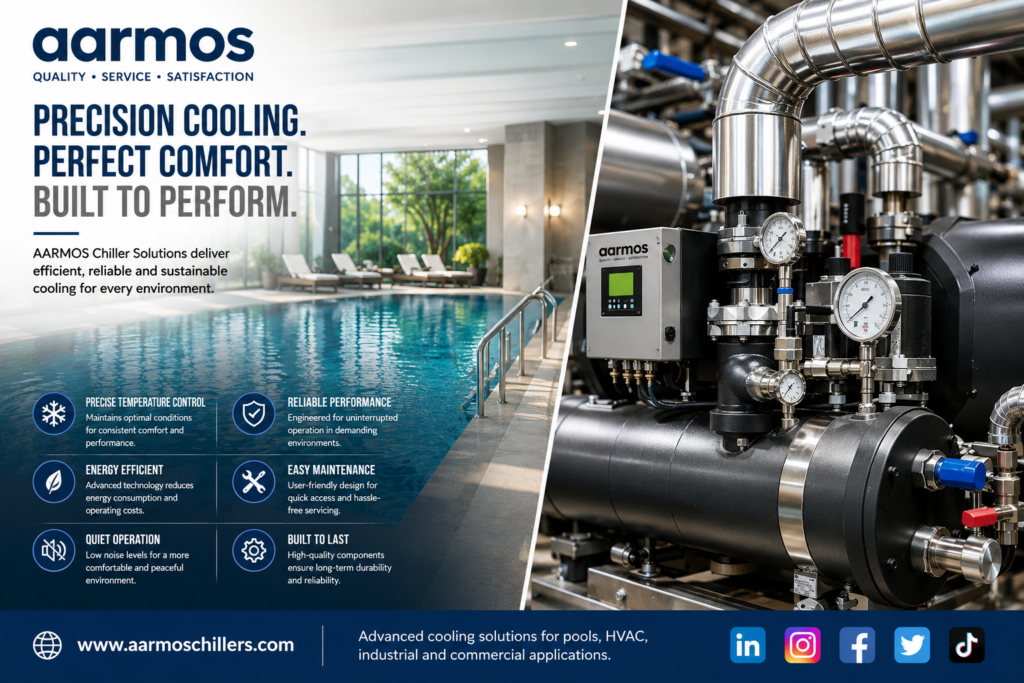
Most indoor pool temperature control systems combine pool chillers, heat pumps, heaters, circulation equipment, and control panels. In warm regions such as the UAE and across the GCC, cooling can be just as important as heating.
Solar gain through glazing, internal building heat, and heavy occupancy often raise pool water temperature above the target range. A dedicated pool chiller or an integrated heat pump solution can solve that problem.
That is where a dedicated pool chiller or integrated heat pump solution becomes valuable. Standard comfort cooling units cannot regulate pool water temperature. Engineers should instead select equipment based on water volume, turnover rate, heat gain, operating hours, and water chemistry.
Material selection matters. Heat exchangers, piping interfaces, and controls should be suitable for the application rather than adapted as an afterthought.
For engineering-led projects, cooling load calculation is the starting point. Engineers should size the system according to the pool dimensions, water volume, indoor conditions, desired setpoint, and expected heat load. Oversizing can lead to short cycling and inefficient operation. Undersizing leads to poor temperature stability and customer complaints.
Chillers vs heat pumps for indoor pools
If the main issue is bringing overheated water back down to a controlled temperature, a chiller is usually the right answer. If the project needs both heating and cooling across different seasons or usage conditions, a heat pump may offer more flexibility. In some facilities, especially commercial or institutional sites, the best result comes from a customized arrangement that integrates pool temperature control with the wider mechanical system.
There is no universal answer. A villa indoor pool with occasional use has a different operating profile from a hotel spa or school training pool. That is why equipment selection should follow the actual application rather than a catalog shortcut.
Common indoor pool problems caused by poor temperature control
When operators say the pool system is “working,” they often mean the water is circulating and the temperature looks close enough. In reality, poor control shows up in slower, more expensive ways.
One common issue is drifting water temperature. This usually points to incorrect equipment sizing, poor control logic, or inadequate heat exchange capacity. Another is high humidity in the pool hall, which often starts with excessive evaporation from overheated water. Facilities may also see increased chemical consumption because water temperature affects sanitizer behavior and bather load response.
There is also an equipment life issue. Pumps, control components, and support systems tend to perform better when the pool operates within a stable design range. Constant correction, frequent cycling, and unmanaged heat gain create wear that could have been avoided through better engineering.
What good system design looks like in practice
A reliable indoor pool system starts with the load calculation, then moves to equipment selection, hydraulic design, control strategy, and installation quality. That sounds straightforward, but it is where many projects separate into long-term performers and long-term service calls.
The control strategy should be simple for the operator but technically sound behind the scenes. Water temperature sensors need proper placement and calibration. Flow through the heat exchanger or chiller loop must stay within design limits. Controls should respond steadily, not aggressively, so the system avoids overshooting the setpoint.
In many projects, insulation and piping layout also affect performance more than owners expect. Heat gain in exposed pipework, poor circulation balance, or long pipe runs can all make the system work harder. For indoor pools, the mechanical room environment matters too. Service access, ventilation, drainage, and corrosion protection should be considered from the start.
A practical project approach
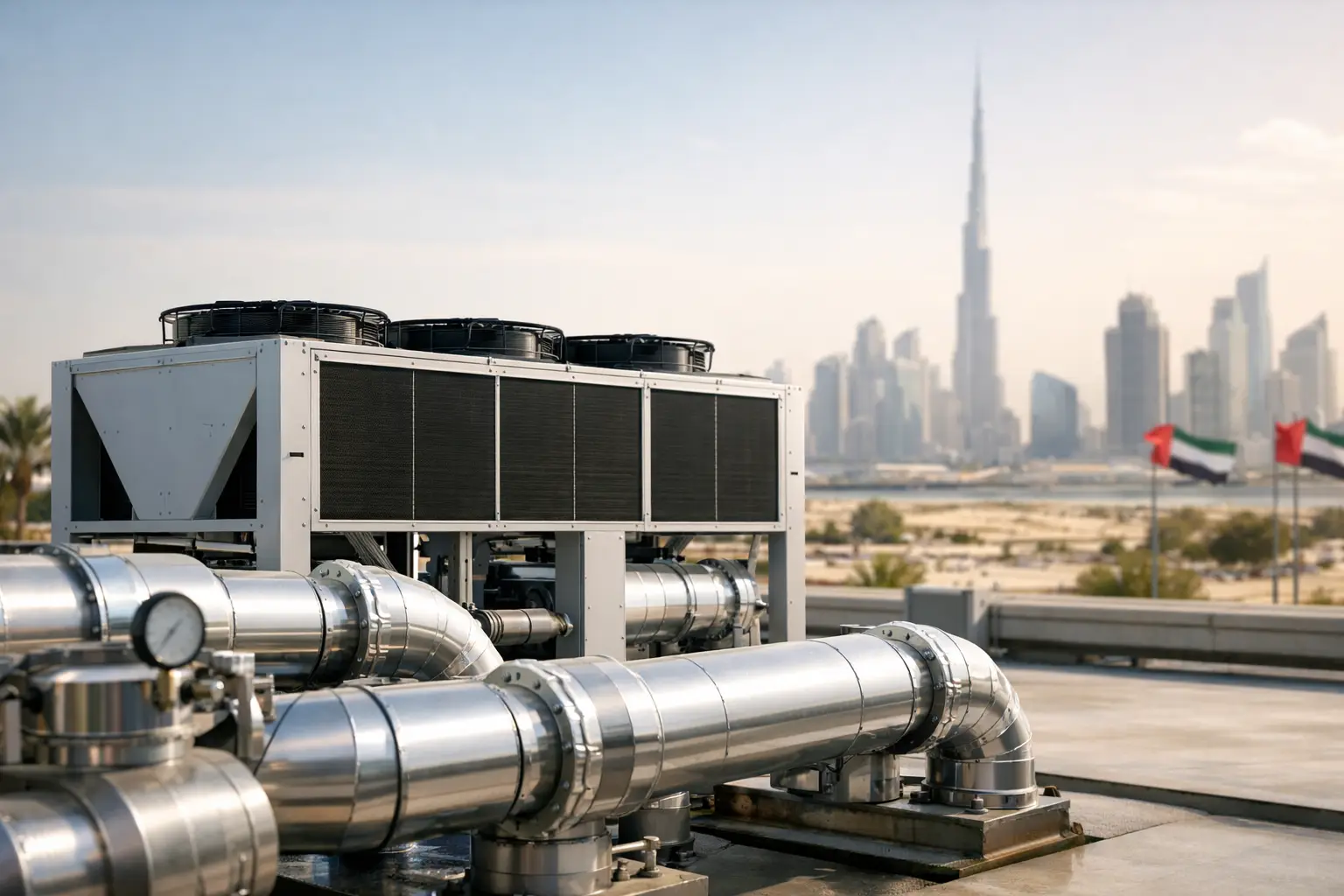
In a recent style of villa or commercial indoor pool application common across Dubai, Abu Dhabi, and other Gulf locations, the challenge is often not extreme winter heating but year-round control in a warm ambient environment. In those cases, the right pool chiller can maintain a stable water setpoint even when surrounding conditions push temperatures upward. The measurable benefit is not only swimmer comfort. Operators also see more consistent water quality, less unnecessary energy use from incorrect equipment operation, and fewer complaints during peak heat periods.
For a project-driven company such as AARMOS, this is where engineering support matters. The value is in understanding the site, calculating the actual load, selecting suitable equipment, and supporting installation and after-sales service so the system performs as intended.
Maintenance and operating habits that protect performance
Even a correctly designed system can lose efficiency if maintenance is neglected. Fouled heat exchangers, clogged strainers, incorrect flow rates, and sensor drift all reduce temperature control accuracy. Indoor pool operators should treat preventive maintenance as part of performance, not a separate service issue.
Water chemistry also plays a role. Poor chemical balance can damage heat transfer surfaces and shorten component life. If a facility experiences unstable temperatures, the cause may not be the chiller itself. It could be restricted flow, scaling, or control faults elsewhere in the loop.
Routine checks should include operating temperatures, pressure readings, water flow, control response, and visible signs of corrosion or condensation around the equipment room. When these are tracked consistently, small problems are caught before they turn into downtime.
FAQs about temperature control for indoor pool systems
What is the best temperature for an indoor pool?
It depends on the application. Leisure pools, lap pools, therapy pools, and spa areas all have different target ranges. The best temperature is the one matched to swimmer use, room conditions, and humidity control strategy.
Do indoor pools need cooling as well as heating?
Often, yes. In warm climates or enclosed spaces with solar gain and high occupancy, water can rise above the desired setpoint. A pool chiller or reversible system helps maintain stable conditions.
Why does warm pool water create humidity problems?
Warmer water evaporates faster. In an indoor pool enclosure, that moisture stays in the building unless it is controlled by proper ventilation and dehumidification.
Can a standard HVAC system control pool water temperature?
No. Building HVAC may influence room air conditions, but pool water requires dedicated temperature control equipment designed for water-side heat transfer and pool operating conditions.
How do you size a pool chiller for an indoor pool?
Sizing should be based on cooling load calculations that include pool volume, desired water temperature, indoor air conditions, occupancy, operating schedule, and site-specific heat gain.
If you are planning an indoor pool or trying to correct an existing temperature issue, the smartest next step is not guessing the setpoint. It is reviewing the system as a whole – water, air, load, controls, and equipment – so the solution fits the way the pool is actually used. If you need engineering support for swimming pool temperature control in the UAE or GCC, contact AARMOS to discuss your project requirements and system performance goals.
Recent Comments
No comments to show.